
Sumaiya Dola Presents Poster at Biomedical and Health Informatics Conference
Fri. Jan. 2, 2026
Sumaiya Sultana Dola is a Master of Science student in the Applied Computer Science and Society program. Under the supervision of Dr. Camilo Valderrama, Sumaiya’s research lies in the area of biomedical and health informatics. Sumaiya recently travelled to Atlanta, Georgia to present her research, some of which has already resulted in peer-reviewed publications, at the 2025 IEEE-EMBS International Conference on Biomedical and Health Informatics.1
We checked in with Sumaiya to learn more about her research and the conference.
Thanks for taking the time to connect with us, Sumaiya. Can you tell us what your work involves, and what made you pursue this area of research?
My work involves developing interpretable, data-driven approaches to improve the identification and assessment of health risks in newborns. I chose this area because I aim for my research to have a real impact on healthcare and to support better decision-making in maternal and infant health.
Congratulations on being accepted to the IEEE-EMBS BHI! What was your role in the conference, and what made you decide to apply?
I presented a poster based on our paper “Identifying Birth Weight Cutoffs Based on Maternal Height and Apgar Scores.” In this research, we explore why the standard World Health Organization (WHO) low birth weight cutoff may not consistently reflect health risks across diverse populations. As a result, we proposed a more adaptive approach that uses maternal height, infant sex, and Apgar scores to estimate cutoffs that better align with newborn health status.
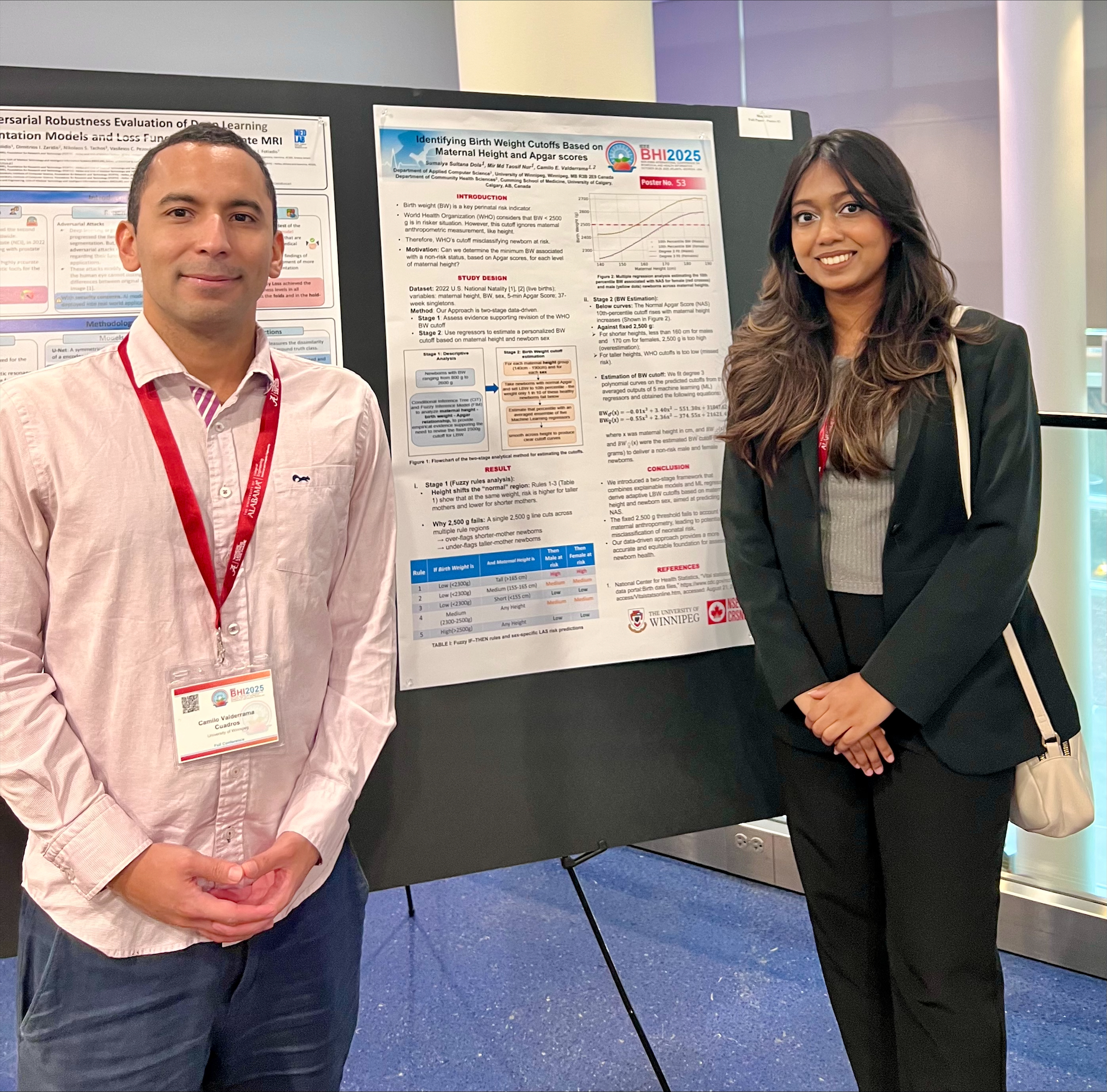 I applied to this conference because BHI is a leading event in the field of biomedical and health informatics. It closely aligns with my research focus on developing clinically meaningful and interpretable methods for newborn risk assessment. With a reported acceptance rate of 29.3%, BHI has a competitive review process that ensures the program features a concentrated group of researchers presenting rigorously reviewed work. This makes it valuable for me to share our results, learn from others' approaches, and establish connections for future collaboration.
What were some of the connections between your research and other events at the conference? Did you have a chance to connect with or socialize with researchers from other institutions?
The structure of BHI, with its keynotes, panels, and technical sessions centered on AI in healthcare, is closely aligned with my research interests. Many sessions focused on making medical AI not only accurate but also trustworthy and practical for real clinical settings. I also found the panels featuring industry experts and young professionals particularly relevant, as they emphasized the practical application of these concepts and highlighted the essential skills needed to address real health AI challenges, including the ability to communicate results clearly to multidisciplinary audiences.
During the poster sessions and the reception, I had the opportunity to meet researchers and graduate students from various universities. We exchanged ideas about health AI, and I received valuable feedback on my poster. I also connected with a few individuals working on related problems, and I would like to stay in touch with them.
What was the highlight of the conference for you and what are you going to take away from your experience there?
The highlight of BHI for me was the overall experience of being part of a global research community. I had the opportunity to present my paper, attend sessions focused on AI and health informatics, and connect with students and researchers from various institutions. This experience helped me build confidence in communicating my work to a multidisciplinary audience and gave me insight into how others tackle similar challenges in healthcare AI.
My main takeaway from the event is a renewed sense of motivation and direction. I am leaving with clearer next steps for my research, new ideas to enhance my work, and valuable connections that I hope to build in future collaborations.
Do you have any advice for students about to attend their first conference?
Based on my experience, my advice for students attending their first conference is to treat it as both a learning opportunity and a chance to build their research community. Prepare a brief introduction to your work, with both a 30-second version and a 2-minute version ready. Don’t hesitate to engage in conversations, as most attendees are open to discussions, especially during poster sessions and breaks.
Use the conference to gather feedback on your research and to explore new ideas by attending sessions slightly outside your exact topic. If you’re considering pursuing a PhD or a future research role, conferences are excellent venues to meet potential supervisors and collaborators. You can also learn about the research activities conducted in different labs and understand the current active research directions.
Finally, take notes on the questions you receive and the interesting talks you attend. Those notes often provide a clear roadmap for areas to improve or explore next.
Notes
1. Sumaiya's publications include "Developing Adjustable Birth Weight Cutoffs Based on Maternal Height and Apgar Scores" in Machine Learning: Health (with. M. Nur and C.E. Valderrama), "Exploring parental factors influencing low birth weight on the 2022 CDC natality dataset" in Medical Informatics and Decision Making (with C.E. Valderrama), and "Identifying Birth Weight Cutoffs Based on Maternal Height and Apgar Scores" in the IEEE-EMBS International Conference on Biomedical and Health Informatics (with C.E. Valderrama).