
Toolkit 1: Community Safety Conversation
By Stacy Cardigan Smith
Summary
A safety conversation is an opportunity to introduce caring and inclusive safety concepts to community members as they build connections and share experiences. Safety conversations can provide insight about what approaches might be a good fit for your neighbourhood, allowing your group to develop a responsive, community-informed strategy.
A facilitated discussion was SVRA’s first major safety-related event, which we combined with our Annual General Meeting. The first part of this toolkit describes how and why we organized the event and what we learned. The second part covers how we designed the activity itself, how we used it, and what we found.
Why host a community safety conversation
- Community safety is often a big topic in communities and can be divisive.
- A facilitated conversation allows research findings to be shared, community members to feel seen and heard, connections to be built, and a shared understanding to be sparked.
- By reflecting on discussion questions, community members provide feedback and insight that can inform future strategy and activities.
What does the conversation achieve
- Builds shared understanding of what “safety” and “caring and inclusive” mean.
- Allows the organization to gather community insight which informs strategy.
- Supports other community development activities like building connections
- Allows community members to understand what type of actions they can take, and take ownership of how they can make a difference.
Things to consider
- Why will people want to come to this event? What’s in it for them/why should they care?
- How will you manage that this may be a difficult and triggering conversation for some attendees?
- How will you measure success?
- How will you gather information to inform future activities and strategy?
- If you gather information, how will you share it back with the community to build trust and to demonstrate appreciation for their insight and the action you are taking as a result?
- Do you want to hold this event in conjunction with your AGM?
- We have found that holding a fun/interesting community event in conjunction with our AGM gets people out to our AGM who might otherwise not attend.
- Food brings people together, but consider when you will serve it. You don’t want people to eat and leave before they participate in the conversation.
- We served food after the safety conversation and before our AGM (we started the AGM portion as people were still eating).
- To promote inclusion of people caring for children, it’s always a good idea to have childminders on site.
What you might need
- Someone with the time and energy for planning and logistics to act as an event lead.
- Someone who can lead volunteer recruitment and training (see details in Toolkit 4).
- Someone who can handle marketing and communications (see details in Toolkit 5).
- Someone who is familiar with the research to share the findings.
- A skilled facilitator who can provide insight into designing and chairing the discussion and who is trained in de-escalation.
- Someone with lived experience doing inclusive safety work (hint: look for someone who is involved with a local nonprofit or charity).
- Someone to lead data gathering and analysis.
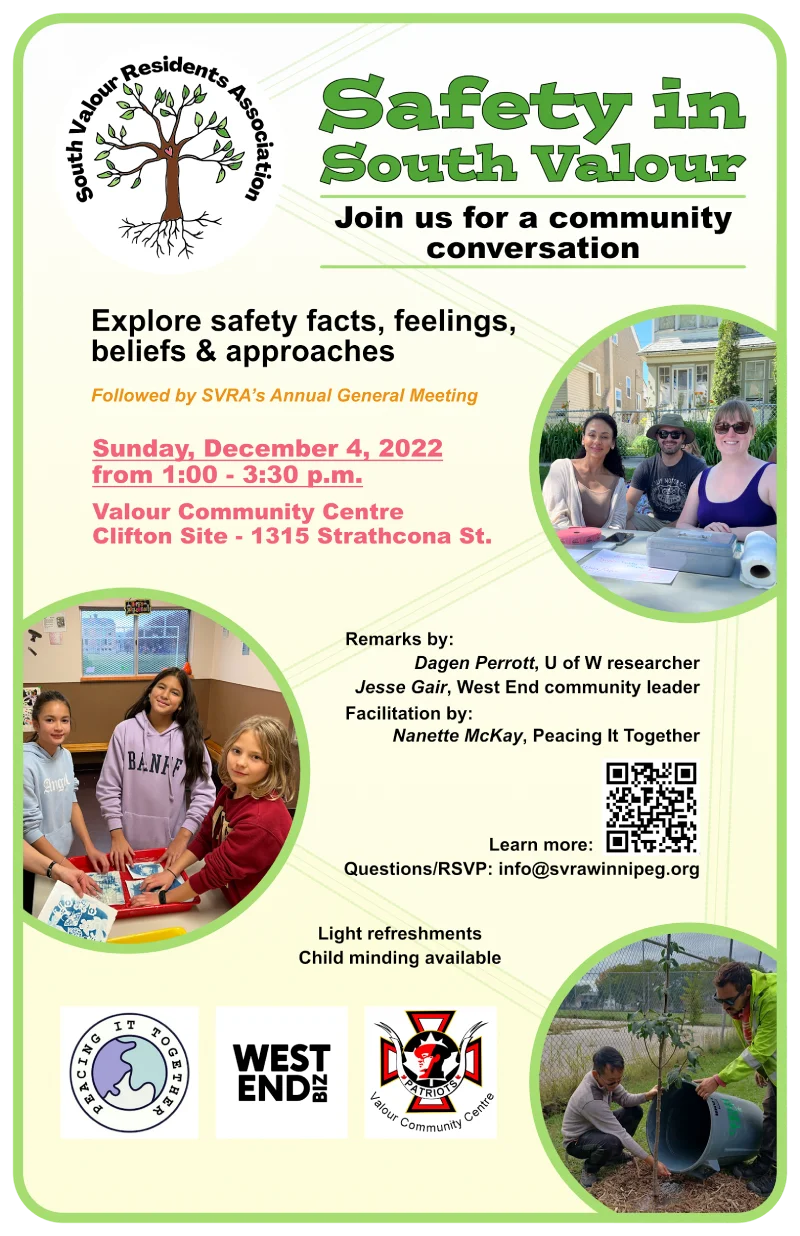 The event flyer for Safety in South Valour: Join us for a community conversation. Text reads: Explore safety facts, feelings, beliefs and approaches, followed by SVRA’s Annual General Meeting. Sunday December 4, 2022 from 1-3:30pm at Valour Community Centre Clifton Site. Light refreshments and childminding available. It names the speakers (Dagen Perrott and Jesse Gair) and facilitator (Nanette McKay).
It was important to create a space where everyone in our community felt welcome to participate and share in dialogue, to learn about and unpack what caring and inclusive community safety looks like, and to explore what these approaches mean for our community. The focus should be on discussing solutions that support equity for all.
Goals of the event:
- Create a space where all community members feel welcome.
- Share caring and inclusive safety approaches.
- Ask community members for their feedback about how we could use these approaches in our neighbourhood.
- Collect and analyze feedback to inform SVRA strategy.
- Share back with community what we heard and what we will do as a result.
Target audience:
- Community residents.
- People who work and play in the community.
- Residents from neighbouring communities, including representatives from nearby residents’ associations.
- Invited guests, including City Councillor, Member of Legislative Assembly, Member of Parliament, etc.
Creating an inclusive space and gathering community insight:
We hired a professional facilitator to lead the discussion and maintain a respectful atmosphere where everyone could be heard. The facilitator was present as a third party, meaning they didn’t have a stake in the outcome. Their goals were to be fair and impartial and to create a respectful space. They were also trained in de-escalation.
We also identified and trained volunteers to act as table facilitators. These volunteers kept attendees engaged in the activity and documented the discussion. Having six people at each table, including the facilitator, allowed each attendee to participate.
We developed questions that allowed attendees to reflect on what they heard, share insight about how to take action in our community, and take personal responsibility for concrete actions. Our questions:
- What did you hear that was new to you?
- What could this approach to safety look like in our community?
- What is one thing you as an individual can do to support this approach to safety in our community?
We considered different learning styles and encouraged facilitators to ask attendees to reflect on the questions and jot down ideas or answers before beginning the discussion, giving people time to gather their thoughts.
We developed feedback forms so people could provide further insight in case they didn’t feel comfortable sharing in person. Feedback could be about the safety research and discussion, event design, or whatever the attendee felt like sharing. Written and electronic forms (accessed via QR code) were available.
- We held the conversation in a local community club that was physically easily accessible.
- We set up a registration table at the front with sign in sheets and nametags.
- We also had sign up sheets for people to receive our electronic newsletter and to volunteer.
- We set up a space for presenters at the front of the room.
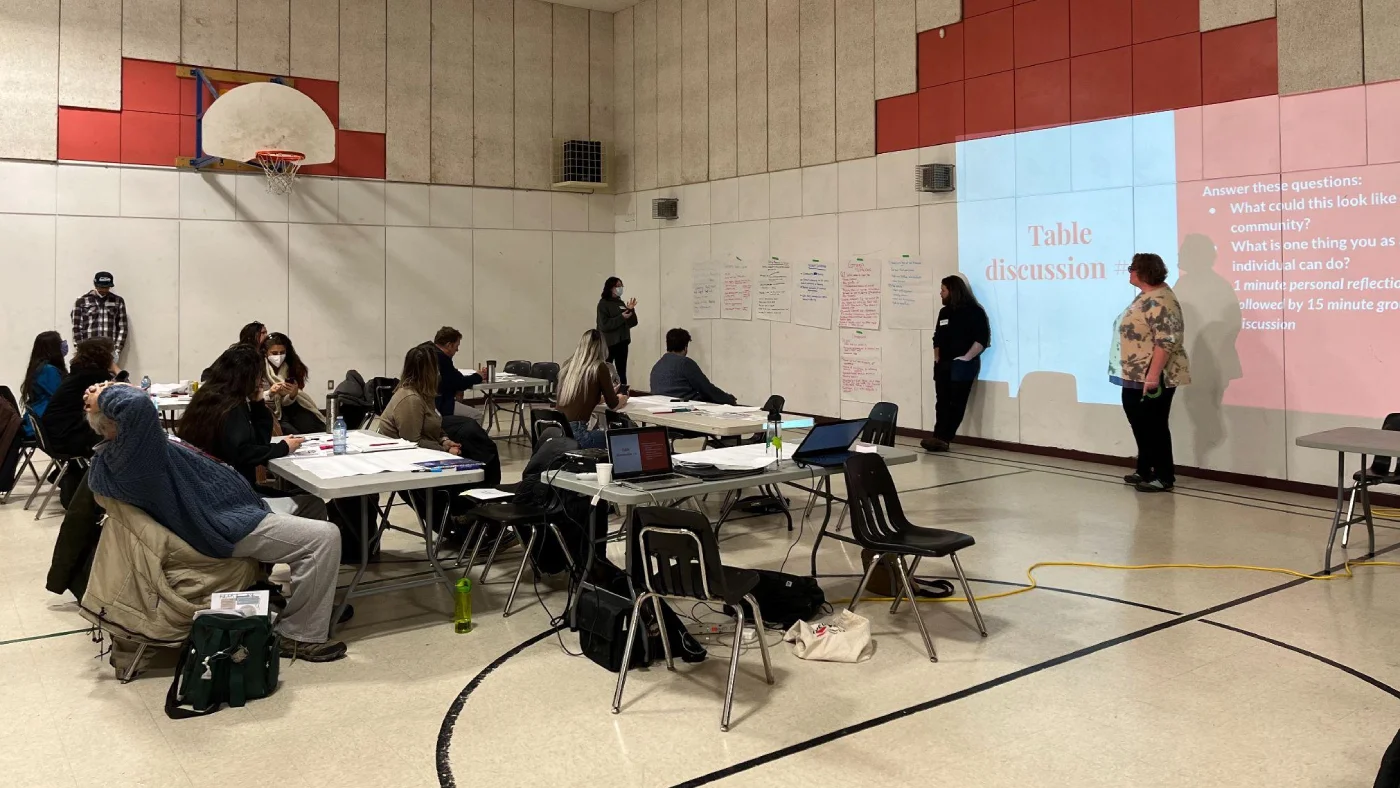
- We developed a PowerPoint and used a projector to share the slides.
- We printed out copies of the inclusive safety one-pager and infographics
- We set up tables, each with seating for six people. We identified a volunteer facilitator for each table to facilitate discussion and take notes.
- Each table had large poster paper for note taking, scrap paper, markers, materials sharing research findings (one-pager and infographics), and printed surveys and a QR code to an electronic survey so people could provide feedback about the event.
We started by welcoming everyone, introducing our organization and our work exploring caring and inclusive approaches to safety, and outlining the goals of the event.
Our facilitator explained that their role was to create a space where people could fully engage and share their experiences and opinions about a sensitive topic. They worked to foster trust and collaboration and manage the discussion process, and were trained in de-escalation.
During the event, Dagen Perrott shared the six anti-oppressive approaches to community safety that came from the literature review. He focused on sharing information that would encourage reflection and provided examples of how the community could take action.
The former executive director of a local community renewal corporation and a West End community leader shared their experience doing this work. Hearing from someone with lived experience who can talk about putting these concepts into action validates the research and ensures it is relevant, ethical, and impactful.
Attendees sat in small table groups, and each table had an SVRA board member or community volunteer to act as a facilitator and gather insight. The table facilitators worked to create opportunities for each person in the group to share.
This information was then shared back with all attendees during a group discussion towards the end of the event. This allowed attendees to hear what other groups discussed, and to see commonalities and differences.
After the event, the flip chart sheets, debrief notes, and attendee feedback forms were analyzed for key themes and potential action items. This information was used to inform future events and activities. Furthermore, while some of these activities were planned already, when talking about these activities we made sure to reference the connection to safety and the fact that the community asked for this activity during our community safety conversation.
We also held a debrief conversation with SVRA board members and volunteers, as well as University of Winnipeg researchers. We shared our thoughts about what went well and what could have been improved for next time. This conversation was celebratory and action oriented about what comes next, building momentum for future activities.
Our findings:
Key themes that arose during the safety conversation:
- Knowing our space and knowing our neighbours is key.
- Healing from harm: accountability, restorative justice, coming together.
- Perceived safety hazards: graffiti, derelict properties, litter, homelessness, sex work, needles, drug use, encampments (fire risk), derelict properties, walking alone.
- Safety can be personal or property related.
- Safety and security are separate concepts.
- Need to keep getting more concrete with descriptions of “harm” and “action.”
- Community support for policing is still there.
- Clarifying SVRA’s scope.
Potential action items that came out of the safety conversation:
- Graffiti reduction
- Tree planting
- Needle pickup training
- De-escalation training
- Garbage cans, more community cleanups
- Speed limit reduction
- More volunteer engagement; invite volunteers more explicitly; hire a volunteer coordinator
- Repairs and upgrades to community centre
- Connect the community to 211
- Create more awareness of resources/organizations that can help
- Asset mapping
- Share “who to call” lists - cards or magnets? Encourage programming #s into phones for easy access on the go
- Collaborate with other neighbourhoods, residents’ associations
- Public art/guerrilla art
- Community walks
- Expand West End safety partnership to area
- Promote drug testing
- Kid/teen focused events
- Support creation of care bags for handout
- More opportunities for community to share (via survey or more wide-open conversation) about their ideas and perspectives
- Community suppers
- Safety/danger audits
- Improved lighting
- Provide feedback to politicians about what our area needs