
Background Research
By Julie Chamberlain
In the first part of our safety project we gathered knowledge about caring and inclusive approaches to community safety, drawing on articles, websites, reports, and more. Funds from the University of Winnipeg and the Manitoba Research Alliance allowed us to hire a student to put the materials together in an accessible format that was easy to understand.
The report was shared far and wide across Winnipeg. We heard from city workers, school trustees, and neighbourhood residents that they used the report to inform their conversations and planning about community safety. We presented the report to interested community organizations across the city, and our work was featured on a CBC Radio Manitoba story about safety and property crime in Winnipeg.
What we learned
By reviewing work that other scholars and communities have done on the topic, we learned important things about how our neighbourhood could:
- define and talk about safety
- explain the difference between safety and security initiatives
- encourage reflection on the relationship between our feelings, beliefs, and safety
- take action to increase residents’ sense of safety in the neighbourhood
For example, we learned to think and talk about safety as a shared resource and a collective good that communities create. We either all make it together, or we don’t make it at all. Vulnerability and harm are difficult but common parts of human life. As community groups we have choices in how we address them and respond to them at the neighbourhood level.
Common approaches to neighbourhood safety often assume that it is an individual, exchangeable thing – that one person can make themselves more secure (their home, their family) regardless of whether that costs or hurts other people. A community-based safety approach focuses less on building up walls and more on building connections; we share a collective responsibility to look after each other, and research shows that knowing your neighbours and working together is one of the most effective ways to enhance safety.
A caring and inclusive approach means we include everyone in our community, even those who may behave in ways we find challenging. My safety depends on yours, and vice versa. Anti-oppressive action addresses how we often fear people and things that are devalued in our society, and that undermines community safety.
These insights prompted six guiding questions for reflecting on how we even talk about safety in our neighbourhoods:
- Are we discussing safety as something that should benefit everyone?
- Are we recognizing that harm and vulnerability are common parts of human life, and that everyone experiences and does harm in some ways?
- Are we centring what makes us feel safe instead of our fear or discomfort?
- Are we centring community-building that actively keeps us all safe and addresses vulnerabilities, instead of securing the neighbourhood against outsiders?
- If discussing crime, are we talking about actual rates of crime or our fear of crime?
- If discussing fear of crime, are we critically reflecting on the role of prejudice in our fear and discomfort?
Our research also found six key ways that communities can take anti-oppressive action on safety in their neighbourhoods:
What is Safety
Safety can mean more than just an absence of harm or injury.
Safety is the active experience of trust, social connection, familiarity, and support. An anti-oppressive approach to safety improves everyone's sense of safety rather than enhancing the security of a select few. A focus only on security can create exclusion, surveillance, and fear, resulting in the division and isolation of people and communities. True safety requires us to address the root causes of vulnerability and actively create a positive sense of safety.
Facts of Safety
Individual feelings of safety, such as anger, worry and fear, are valid, though they don't always mirror the reality of risks.
Research shows that violent crime is generally decreasing and exclusionary approaches to security are flawed. This requires reflection on our own views of safety, fear of crime, and who we might stereotype as dangerous or criminal. Sometimes shifting beliefs about what makes us safe can be as important as action.
Experiencing Safety
Safety is experienced as an active process of caring and being cared for. It comes from quality of life, knowing your neighbours, a sense of belonging, strong public services and supports, investment in the neighbourhood, accessible transportation, and accountability when harm occurs. Safety is a collective process that requires much more than just a personal sense of security from danger.
5 Questions to Ask Ourselves
- Are we talking about safety as something that should benefit everyone?
- Are we critically reflecting on the role prejudice plays in our fear and discomfort?
- Are we focusing on what makes us feel safe? Or on our fear and discomfort?
- If we're talking about crime, are we talking about actual rates of crime or our fear of crime?
- Are we recognizing that harm and vulnerability are natural and that evervone experiences and perpetrates them?
SOCIAL CAPITAL: Strengthening the sense of connection, reciprocity, and trust within and between, communities
GOOD GREENSPACE: Creating well-maintained and usable parks, gardens, and more
SEEING YOUR NEIGHBOURS: Supporting many different demographics using and sharing public spaces
CARING RESPONSES TO CRISIS: Responding to crisis and harm by de-escalating situations instead of criminalizing people
HARM REDUCTION: Providing supplies, supports, and spaces so that risky activities can be done more safely
STREET OUTREACH: Meeting people where they are at to provide accessible points of support on the street
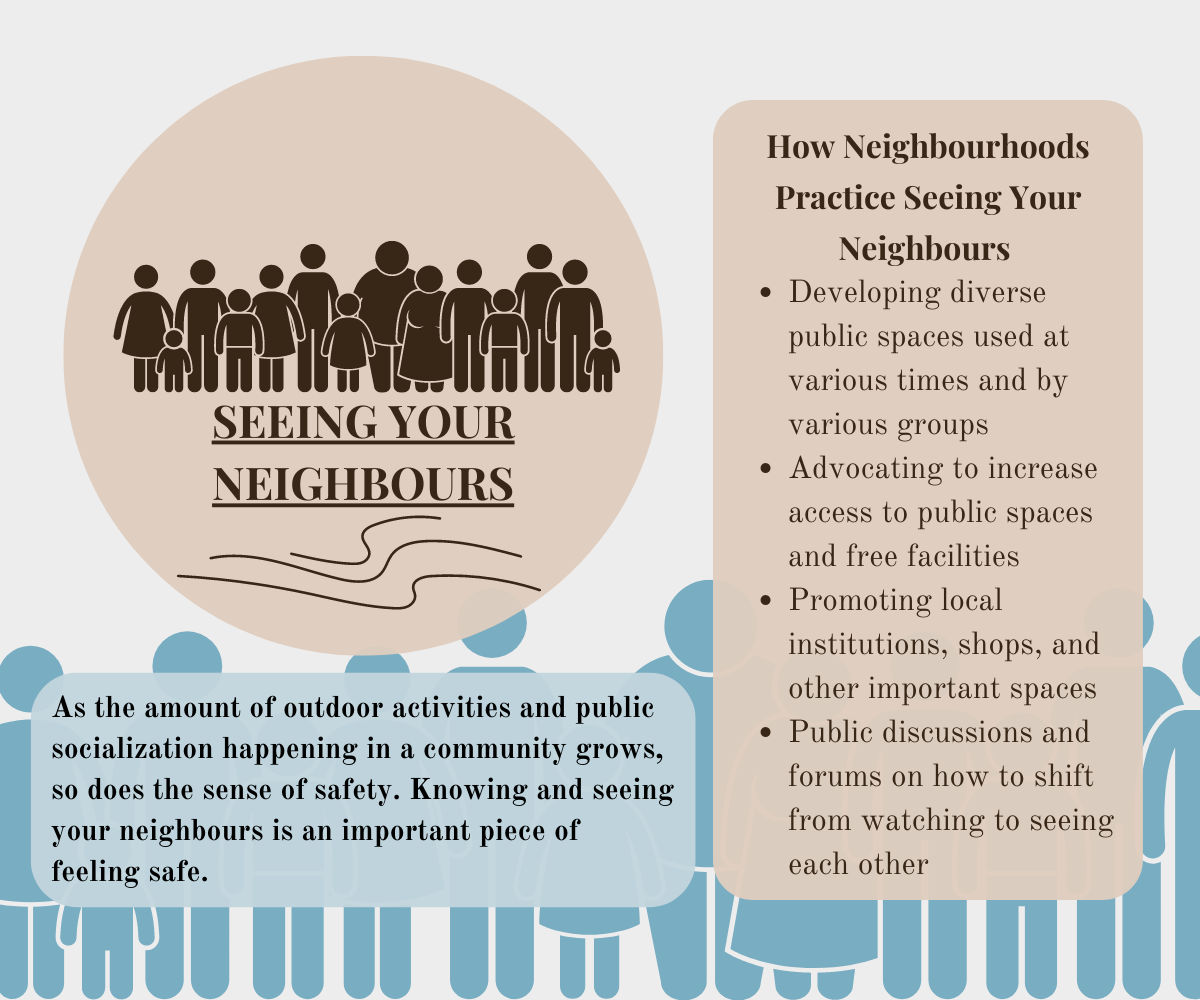
Social networks, trust, and relationships contribute to the safety and overall wellbeing of a community. As reciprocity increases between and within communities, there is increased ability to make change.
How Neighbourhoods Nurture Social Capital:
- Asset mapping
- Organizing events that bring together multiple organizations or groups
- Leading support groups, community kitchens, or other bonding activities
- Inviting residents to participate directly in events and safety strategies
- Art-based programs and approaches to community development
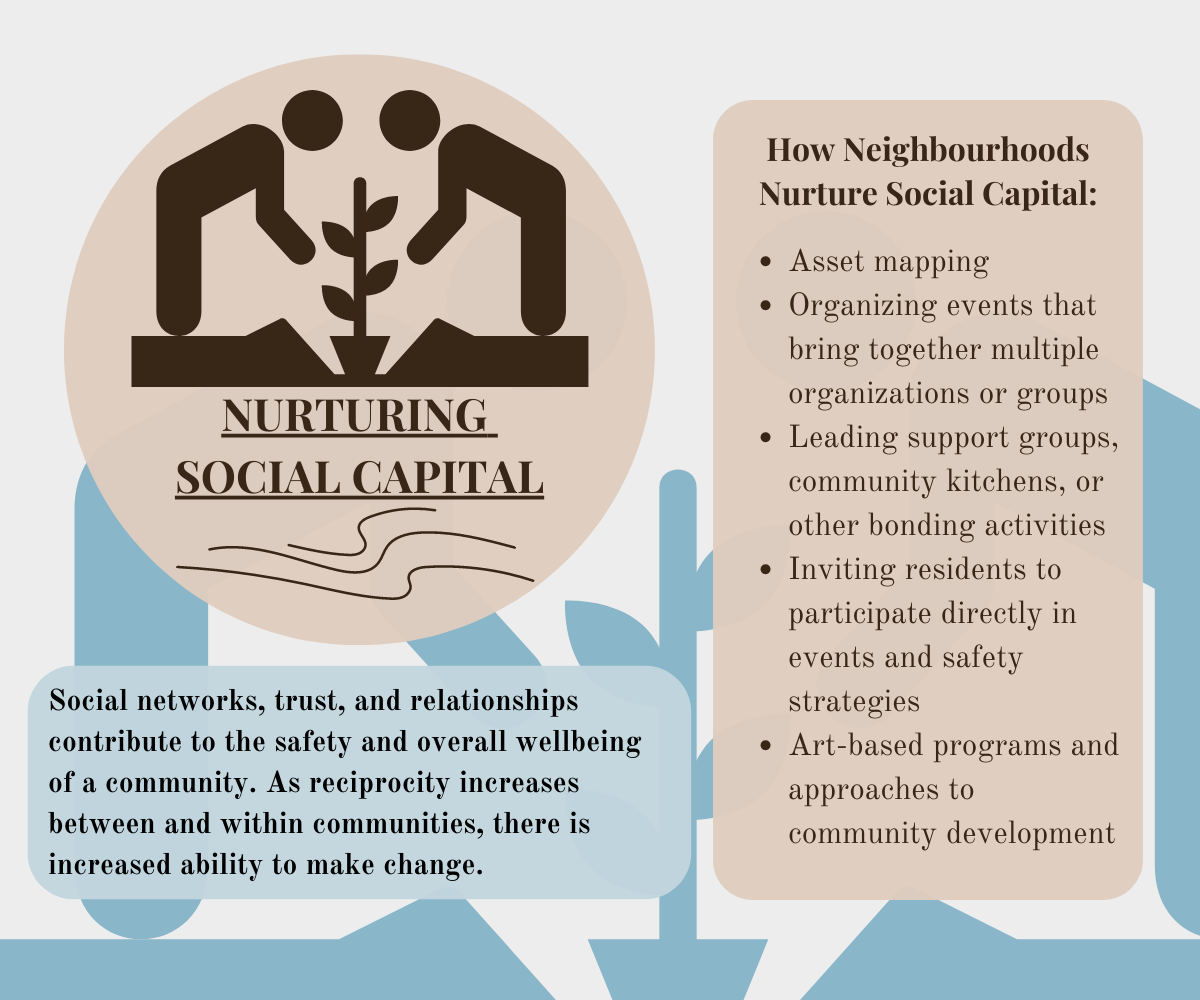
Providing supplies, supports, and spaces to ensure risky activities can be done safely or at least with minimal harm. Harm reduction has improved community quality of life and may also help reduce crime.
How Neighbourhoods Promote Harm Reduction:
- Raising awareness of crisis response lines
- Raising awareness of outreach supports
- Raising awareness of safe spaces
- Compiling lists of alternative resources and making them publicly accessible
- Advocating for the expansion of social supports and non-criminal emergency response services
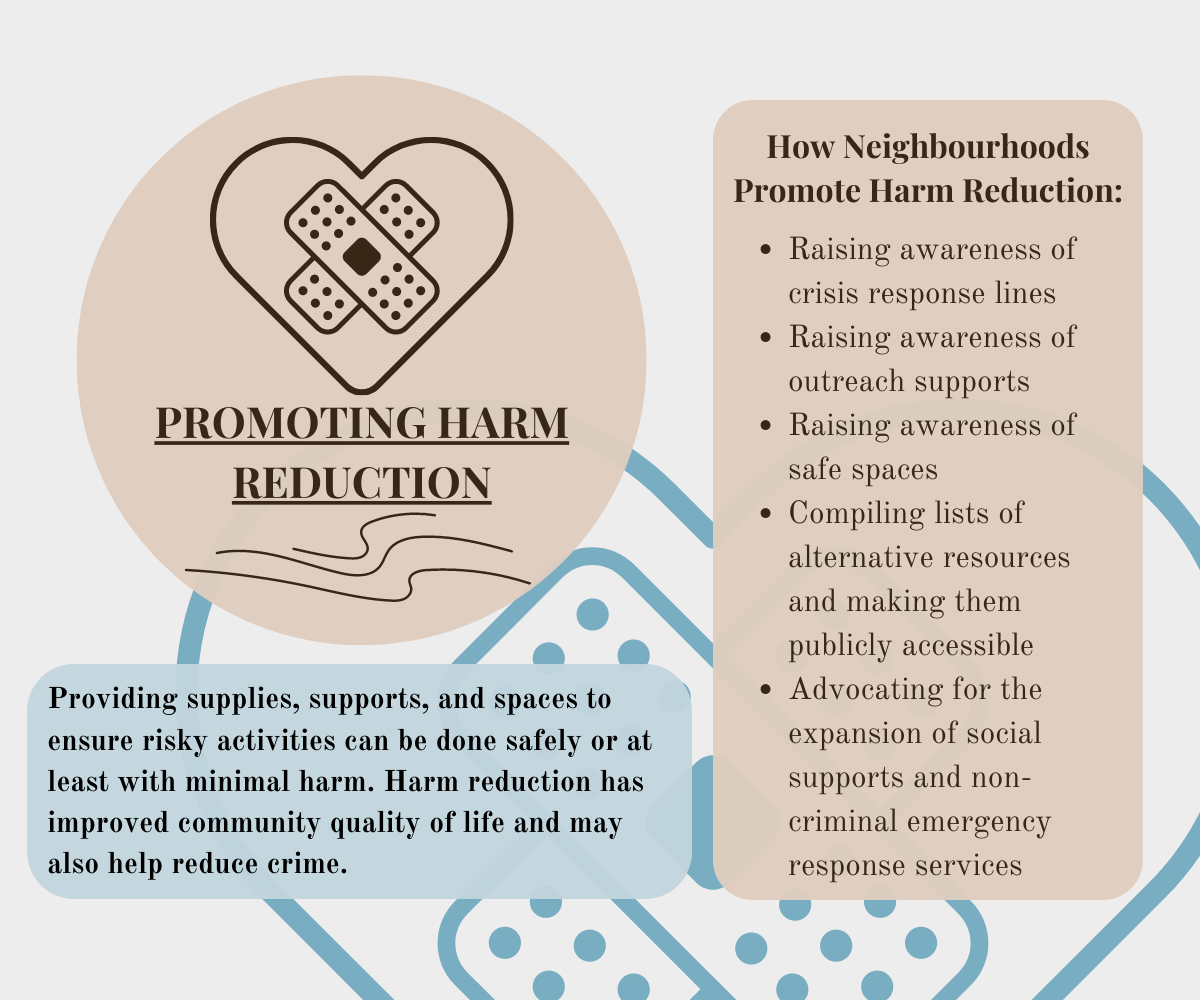
As the amount of outdoor activities and public socialization happening in a community grows, so does the sense of safety. Knowing and seeing your neighbours is an important piece of feeling safe.
How Neighbourhoods Practice Seeing Your Neighbours:
- Developing diverse public spaces used at various times and by various groups
- Advocating to increase access to public spaces and free facilities
- Promoting local institutions, shops, and other important spaces
- Public discussions and forums on how to shift from watching to seeing each other
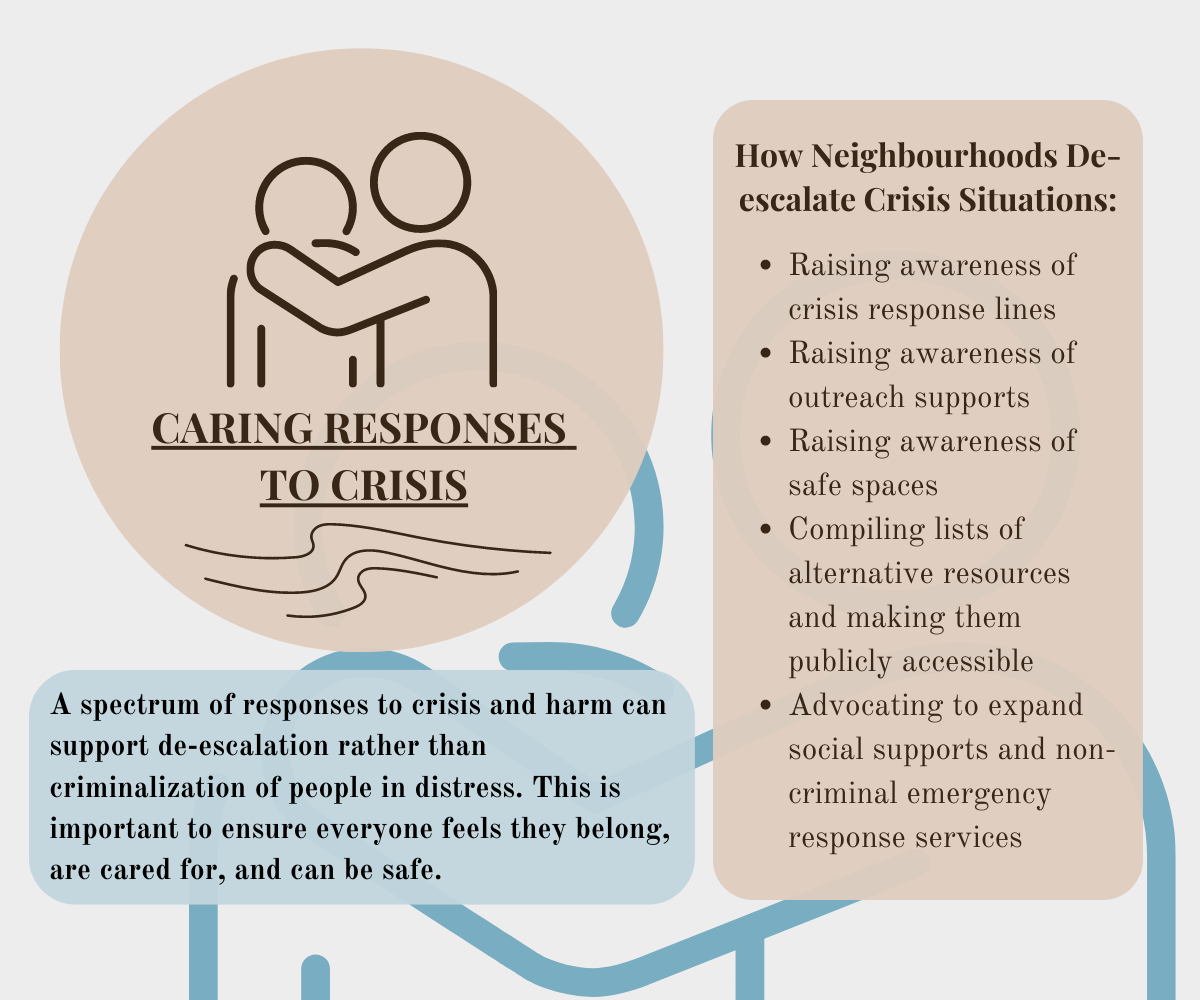
A spectrum of responses to crisis and harm can support de-escalation rather than criminalization of people in distress. This is important to ensure everyone feels they belong, are cared for, and can be safe.
How Neighbourhoods De-escalate Crisis Situations:
- Raising awareness of crisis response lines
- Raising awareness of outreach supports
- Raising awareness of safe spaces
- Compiling lists of alternative resources and making them publicly accessible
- Advocating to expand social supports and non-criminal emergency response services
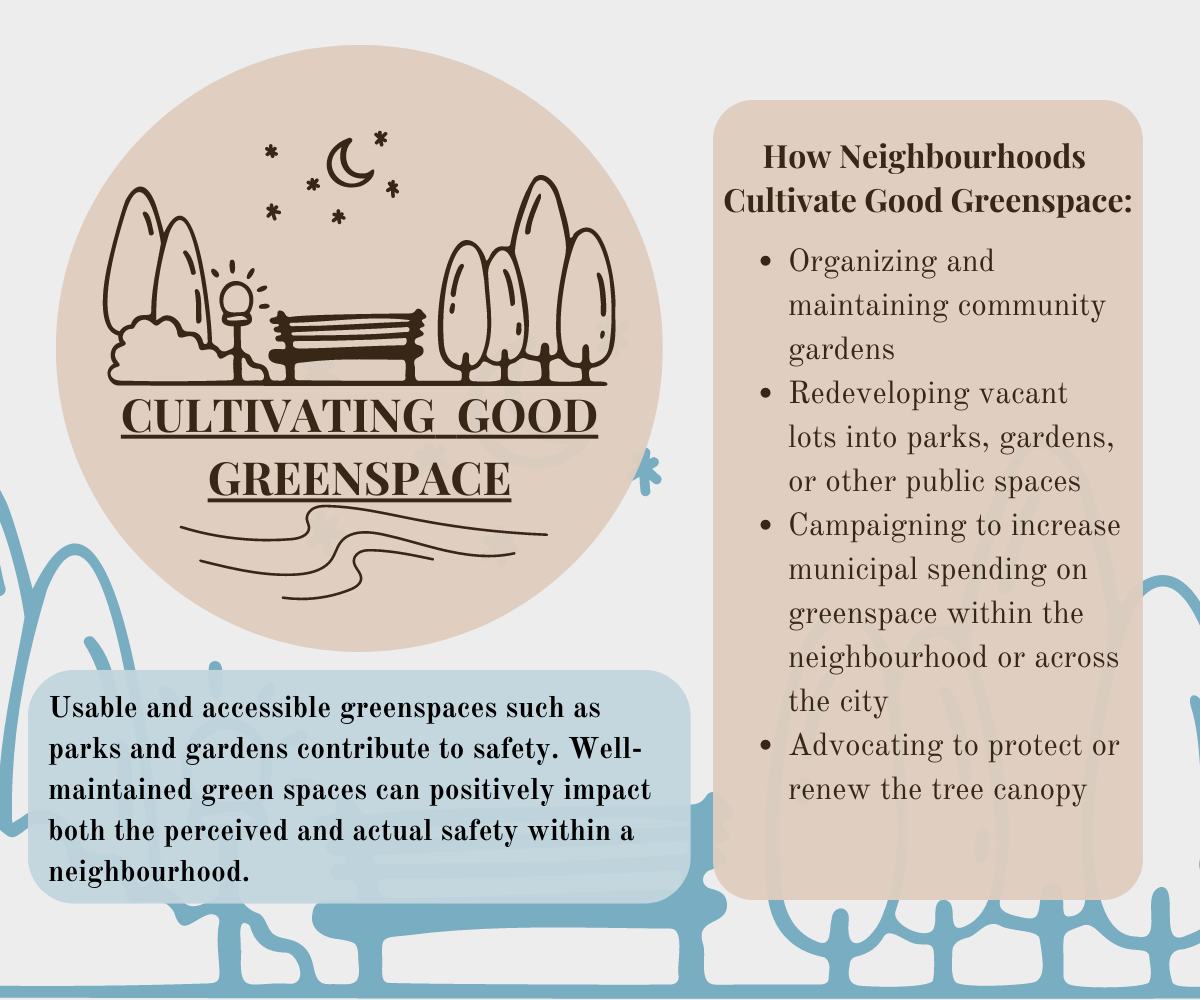
Usable and accessible greenspaces such as parks and gardens contribute to safety. Well-maintained green spaces can positively impact both the perceived and actual safety within a neighbourhood.
How Neighbourhoods Cultivate Good Greenspace:
- Organizing and maintaining community gardens
- Redeveloping vacant lots into parks, gardens, or other public spaces
- Campaigning to increase municipal spending on greenspace within the neighbourhood or across the city
- Advocating to protect or renew the tree canopy
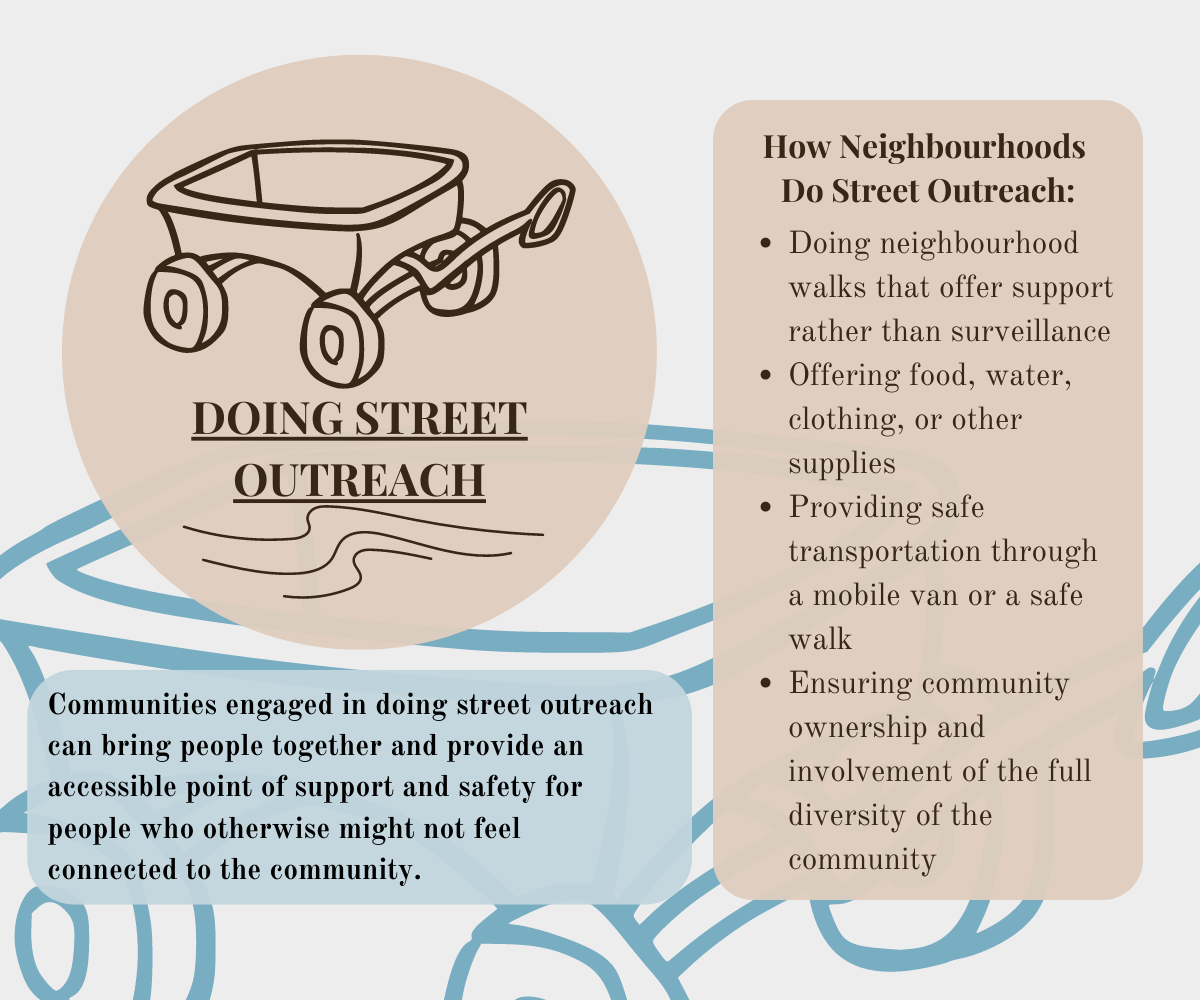
Communities engaged in doing street outreach can bring people together and provide an accessible point of support and safety for people who otherwise might not feel connected to the community.
How Neighbourhoods Do Street Outreach:
- Doing neighbourhood walks that offer support rather than surveillance
- Offering food, water, clothing, or other supplies
- Providing safe transportation through a mobile van or a safe walk
- Ensuring community ownership and involvement of the full diversity of the community
Learn more about these approaches and the guiding ideas in these downloadable resources:
Full report on Grassroots, Anti-Oppressive Approaches to Community Safety
Infographics about all 6 kinds of community action
Why the background research matters
Having this research and various ways of sharing it:
- Helps us decide what to do and what not to do.
- Tells us what kind of actions and events are aligned with our caring and inclusive goals.
- Helps us explain those choices.
- When we say ‘yes’ or ‘no’ to an idea in the community, we can express and back up why.
- Helps us describe how things that seem unrelated are connected to safety.
- For example, when we plant trees we can explain how good quality greenspace makes people feel safer and more comfortable in a neighbourhood. We can explain how funding and support for community development is also an investment in safety.
The background research became the foundation for our actions on safety in South Valour. It informed our conversations within and outside of the community.
“Before I was like, ‘I know I want the neighbourhood to be safer, but I don't know what that means.’ [T]his [research] really helps, and it helps me be able to explain it.” (Sabrina, SVRA Board Chair)
From ideas to action – Creating a logic model
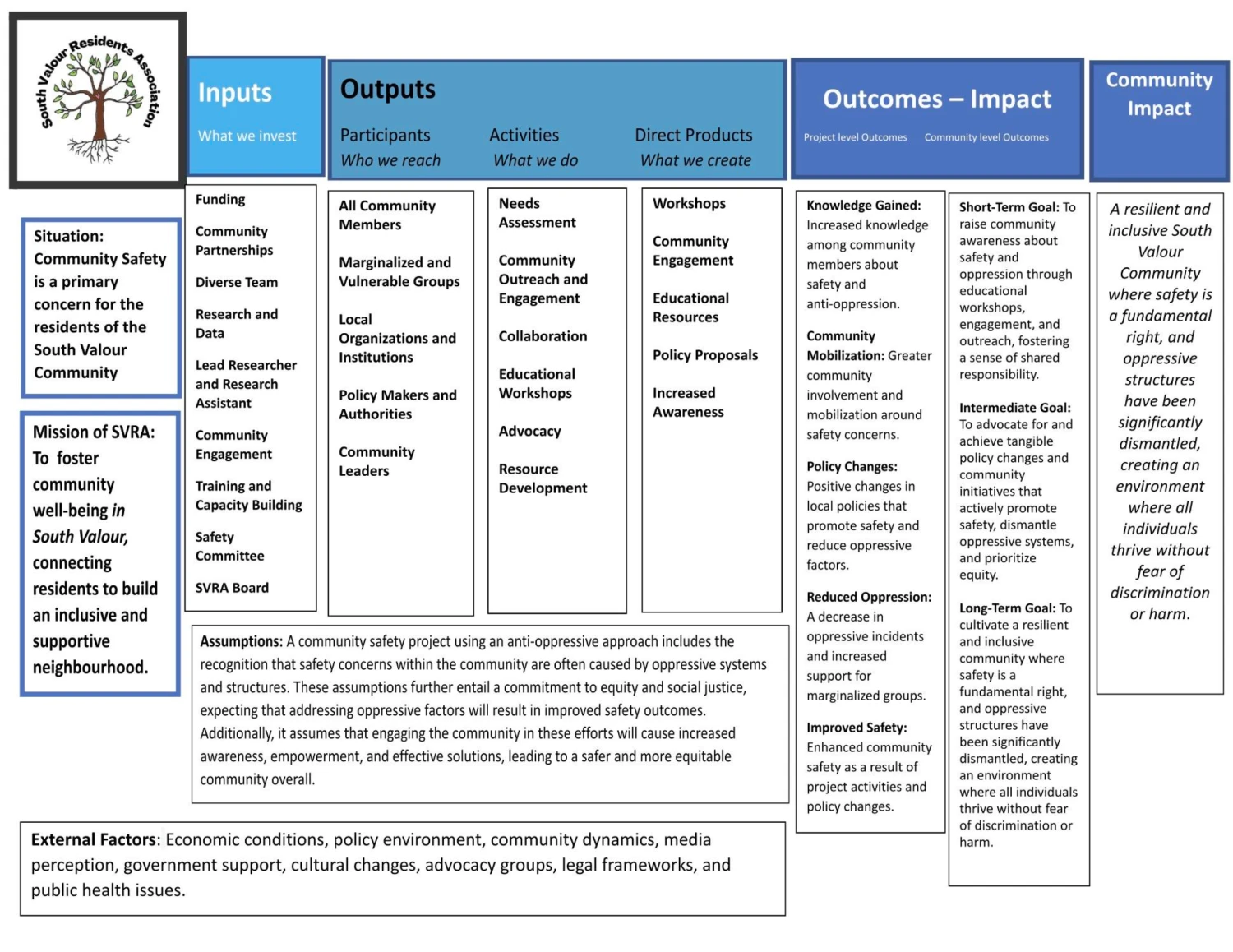
To work out how the background research would shape our project and the future actions of the SVRA, we created a logic model. A logic model is a visual way of showing your plan to use your resources and take action to create an intended effect. Safety Committee member Alexandra Guemili collaborated with researcher Dagen Perrott to develop this logic model, which then served as a touchstone throughout the project.
There are lots of different templates for logic models, depending on how much detail is useful for you. Here’s a simple one that Julie Chamberlain uses with her community planning students.
From ideas to action – Checking how a potential action fits with the guiding ideas
Any multi-year collaborative project needs tools to keep track of what the group is trying to do and how. Community researcher Phuong Tran realized that we needed a way to check how any action we decided to take was aligned with the six approaches we found in our research, our guiding logic model, and eventually with the direction we got from communities through the community safety conversation and the asset mapping event (see Toolkit 1 & Toolkit 2 for more info).
Phuong created a spreadsheet where we could see how proposed events addressed our stated goals, like in the table here. This spreadsheet helped keep us focused, made it easy to say ‘no’ to things that were outside of our scope, and to keep track of which approaches were getting our attention. You can download a blank template here.
Additional resources
You can find a reflection on this part of the project in Engaged Scholar Journal, co-written by Dagen, Julie, and Stacy.