
Toolkit 2: Asset Mapping
Summary
Asset Mapping is an approach to community development that identifies strengths and resources rather than focusing only on deficits or concerns. It offers a chance to identify neighbourhood strengths, opportunities for improvement, and underlying issues people might think about when discussing safety.
 It can be an energy and skill intensive event requiring significant time to prepare the logistics of the event, design the activity itself, analyze what you find, and share it back with your community. It is also an extremely rewarding event that can help build relationships while also providing a powerful evidence base for other events, activities, or advocacy.
This was South Valour Resident Association’s (SVRA) second major safety-related event and we again combined it with our AGM. The first part of this toolkit describes how and why we organized the event and what we learned. The second part covers how we designed the activity itself, how we used it, and what we found.
Why host an asset mapping event on Community Safety
- Asset mapping is a strength-based approach to finding and mapping neighbourhood assets. Assets are the people, places, groups, organizations, or networks that strengthen the neighbourhood.
- It is an interactive tool that allows residents to positively discuss safety and what gives them a sense of it in their neighbourhood, while identifying specific gaps that negatively impact them.
- It can build “social capital” within a neighbourhood, potentially improving people’s sense of safety.
- It provides evidence to help guide outreach, community engagement, and advocacy for the organization.
What asset mapping achieves
- An inventory of the assets in your community, where they are located, and what residents' relationships to those assets are.
- A visualization of the gaps and opportunities in the neighbourhood
- A way to discuss things that may impact safety in a way that is approachable and specific.
- A shared understanding of gaps and issues that can be tackled individually or through your grassroots organization, for example through partnerships, events, or advocacy.
Things to consider
- The questions: What do you want to learn? Is asset mapping the best way to get answers? Would a survey, interview, facilitated conversation, or some other approach work better?
- Putting it into action: What do you hope to do with what you learn? How will you bring back what you learn to the community in order to build trust, demonstrate appreciation for their insight, and show how the results guide your actions?
- Importance: What is your reason for doing this? Why does it matter to you? Why will people want to come to this event and what is in it for them?
- Your capacity: What is your capacity for this activity? Are there additional skills or resources needed to make organizing, designing, and facilitating the activity possible and accessible?
As an example our answers to these questions looked something like:
- The questions: We wanted to learn what ‘assets’ exist in our neighbourhood. Especially where they were located and how often people were using them. We also wanted to know what gaps or issues were seen as impacting safety for residents. A participatory mapping event where we could visualize people’s answers and directly engage with them felt like the right way forward.
- Putting it into action: We wanted to use what we learned to identify assets in the community we could build or strengthen our relationships with. We wanted to identify gaps in safety that we could fill or advocate around. To achieve this we imagined we would create a map with what we learned to be shared within the SVRA. We would also report the findings back to participants and the community with accessible materials such as a short report and infographics.
- Importance: This activity aligned with our commitment to being evidence informed and was an activity requested by participants from our previous safety discussion. We also would be expanding our activities in the next year and could use this for planning next steps. People would come because it is a fun way to shape the future of the SVRA and safety in their community.
- Your capacity: We knew if the activity was part of the SVRA AGM we would have a large capacity for the logistics, promotion, and facilitation of the event. The research team had experience and interest in asset mapping and analysis and were able to take on the activity design. We planned to serve food and offer child minding to make it easier for people to attend.
You might need someone
- With the time and energy for planning and logistics who can act as an event lead.
- Who can lead volunteer recruitment and training (see details in Toolkit 4).
- Who can handle marketing and communications (see details in Toolkit 5).
- Who is familiar with the research and can share the findings.
- Who can lead data gathering and analysis.
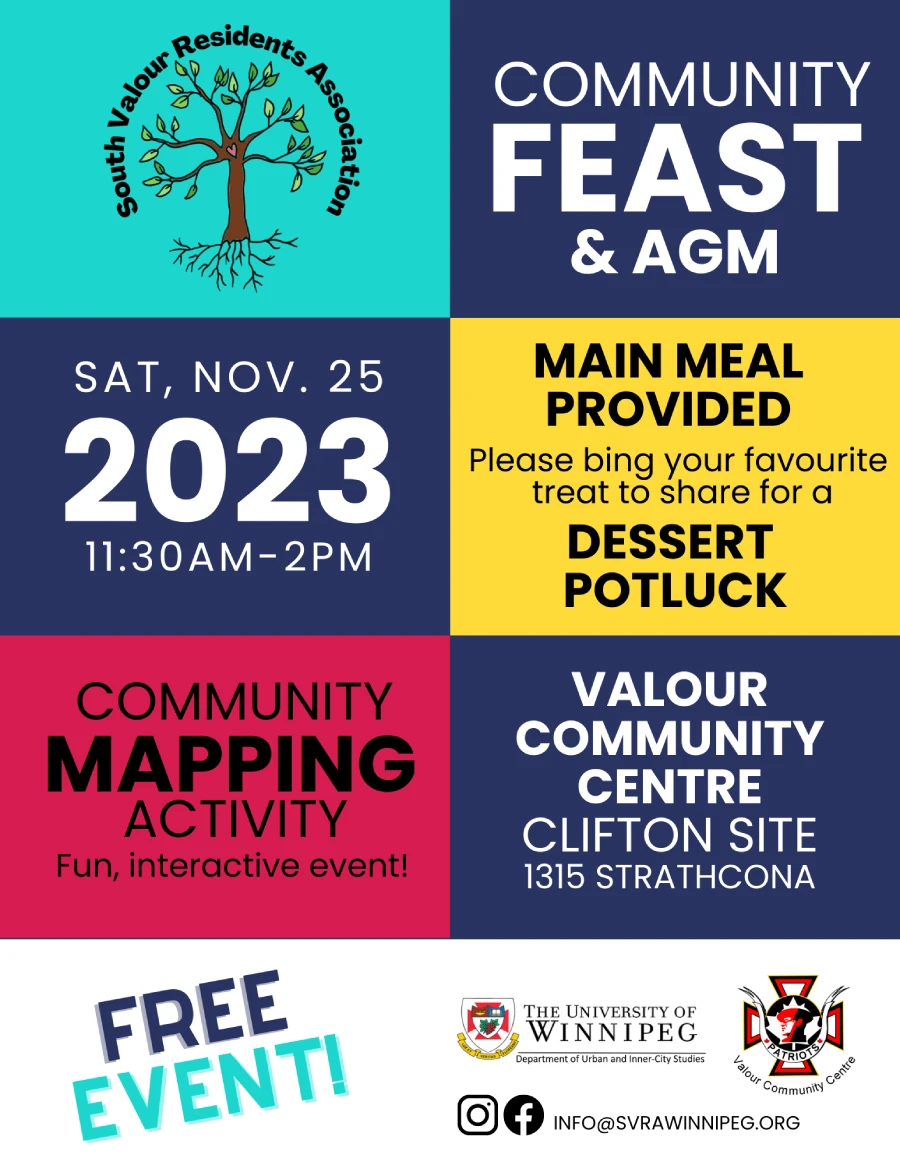
Flyer for the asset mapping event we held alongside the 2023 AGM. The flyer reads South Valour Residents Association Community feast and AGM. Saturday Nov 25 2023 11:30-2 p.m.. Main meal provided, please bring your favourite treat to share for a dessert potluck. Community mapping activity: fun, interactive event! Valour Community Centre Clifton Site. Free event!
When planning for an Asset Mapping activity there are several considerations:
- Activity design:
- How much time will people have?
- How many maps and questions will you ask?
- What will you prepare in advance (e.g. pre-drawn street maps, narrow questions, suggested comments) and what will be designed by the participants as they go?
- Who will facilitate?
- Who is the audience and what questions will be the most insightful? Many of these questions are also tied to the logistics of the event.
- Logistics:
- Who are you expecting to attend?
- Where and when will the event be held?
- How many people are available to volunteer and support?
- What additional resources will be required to make the event accessible and appealing?
- Will you do the activity on its own or will you bundle it with another event (e.g. AGM, Feast, Mural Reveal, etc)
- Communications:
- What is the tone of the event?
- What is the purpose of the event and how will you communicate this?
- How will you promote the event to potential attendees?
- How will you share back what you learn with participants/your community.
Here is how SVRA answered the above questions for our Asset Mapping Activity:
- Activity Design:
- Based on the logistics we decided that the activity would last one hour.
- There were lots of people available to help facilitate and so we were ambitious with the activity design. We aimed for five separate mapping stations, each with two interrelated questions.
- Due to the tight schedule on the day our questions and maps were mostly prepared in advance with quite specific options for participation.
- Members of the SVRA were chosen to facilitate each mapping station and given a detailed facilitation guide to support this (Appendix 3). We chose to aim the activity at the community quite broadly and so the questions were a broad temperature check on key issues. For more information on design and roles consider Asset Mapping Design and Roles.
- Logistics:
- We expected a turnout of around 40 people based on previous activities, with most people attending living within the neighbourhood or the surrounding ones.
- We chose to host the event in fall before the holiday rush at a local community club that was easily accessible and would have a lot of room.
- Most of the SVRA board was available to help out, and we brought in a few extra volunteers who had attended previous events.
- We offered childcare to make sure families could easily attend, though the activity would not be age restricted.
- Based on previous experience we bundled the activity together with a community feast and the resident association’s Annual General Meeting.
- Communications:
- We wanted to ensure the event’s tone and environment was friendly, relaxed, and welcoming.
- We wanted participants to have a chance to meet and converse with neighbours and for everyone to contribute to the extent they wished.
- The purpose of the event was to learn about what assets existed in the neighbourhood, celebrate our strengths, and identify actionable next steps for the SVRA.
- Based on these goals we wanted to make sure we highlighted the activity as one part of a bigger event including a feast. The event itself was described as fun and interactive, rather than as “asset mapping” as that term may be confusing to community members.
When hosting the activity some things to consider include:
- Before:
- How will you welcome people in?
- Can you provide options for participants who may want to only join for part of the activity?
- What will you do to ensure the activity is accessible and understandable for all the participants?
- Can you offer food or snacks and if so when during the event?
- During:
- How will the activity itself run?
- When will volunteers arrive?
- What materials do you need to make sure facilitators are supported?
- After:
- How will you close out the activity?
- Will participants have opportunities for reflection or debrief?
As an example for our activity:
- Before:
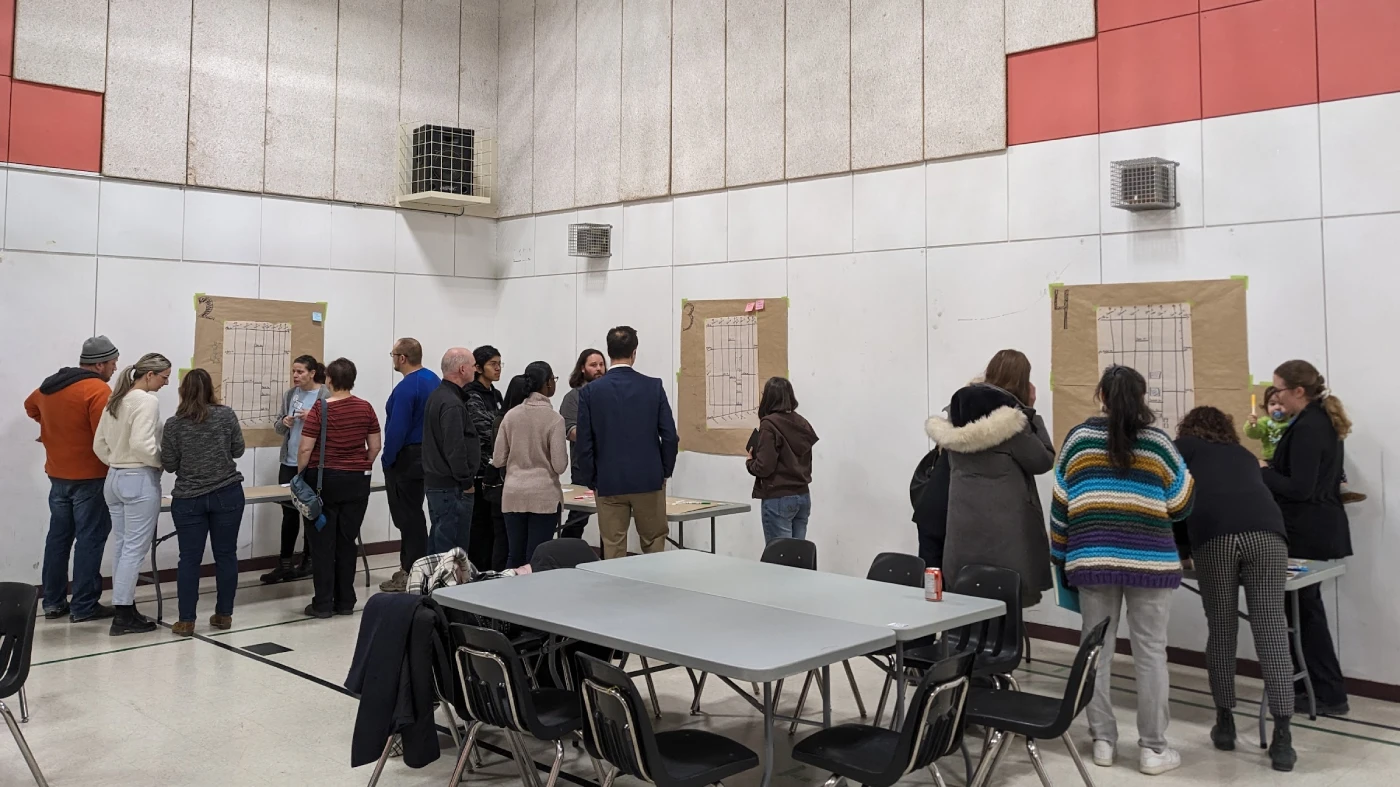
- We set up a registration table with sign in sheets, nametags, feedback forms, and other material. Based on the goals for the space we decided to arrange mapping stations around the edge of the room.
- Each station had its own supplies, map, guide, and facilitator. The rest of the room had tables with 8 chairs each where residents could sit, rest, and return to when not participating.
- Snacks were available throughout and childcare was available in a nearby room in the community club.
- We began with a short PowerPoint presentation that welcomed residents, offered an overview of SVRA, our work on safety, and the agenda for the day. This was followed by a short presentation on what asset mapping is, why we were doing it, how it would be used, and instructions on what to do.
- During:
- Volunteers arrived early and had a chance to ask any questions about their station.
- We split participants into five groups. For one hour each group cycled through each of the five Mapping Stations answering specific questions about neighbourhood assets and safety.
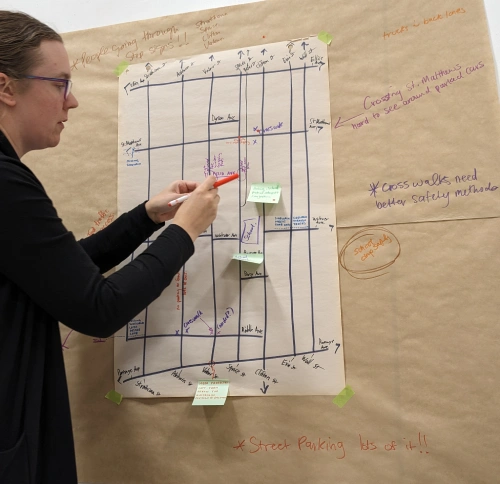
- Each station focused on a question or theme and included an asset map and/or asset inventory. The asset maps showed us where physical assets and safety concerns such as lighting and traffic existed. The asset inventories provided a list of neighbourhood resources and how strongly connected people were to them.
- After:
- We concluded with a short debrief where each station facilitator shared their reflections with the whole room, then we launched into a community feast. Residents were able to informally debrief and chat about the activity with each other and the SVRA during this time.
After you have hosted the activity there are several steps to consider:
- Debriefing:
- How will you debrief the event?
- Where will the debrief happen?
- How will you record the successes and the lessons learned?
- Information:
- Did you get all the information you needed to answer your starting questions?
- Were new questions raised?
- Were there voices left out of the activity that you could reach out to?
- Analysis:
- Who will lead the analysis?
- Who will participate in the analysis?
- What are the questions that you will answer?
- Sharing the findings:
- What will you share back to the community?
- How will you share it?
For us these steps looked like:
- Debriefing:
- A few weeks after the event we held a facilitated debrief of the event at a neighbourhood brew pub. The informal and relaxed setting encouraged SVRA members to reflect on their experience facilitating the maps, what stuck with them since the activity, and how they would like to see the information used.
- One of the UWinnipeg researchers developed a series of prompting questions, while the other took notes. This was an invaluable part of this event which helped us better understand the conversations we had during the activity, what the maps meant, and what was important to the community and SVRA members.
- This conversation provided more guidance on how exactly SVRA wanted to use the maps and what our next steps would be.
- Information:
- Based on our debrief we decided that we were missing youth perspectives on safety as they were mostly absent from our event.
- One SVRA member was particularly keen on making sure youth had their voices heard so they hosted a simplified version of the activity with two dozen youth in Grades 6 through 9 at the neighbourhood school. The results were added into the final analysis and findings.
- Analysis:
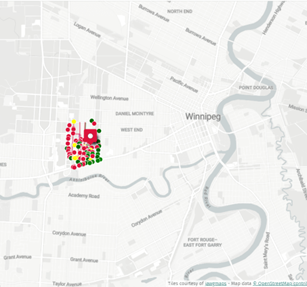
- The researchers took the lead on analyzing the maps. Through the debrief process and frequent meetings with the SVRA sharing updates and getting feedback, we created a digital version of the maps using UMap which SVRA members could interact with. We focused the analysis on answering: 1) What are the key asset areas of the neighbourhood; 2) What are the broad concerns residents have; and 3) What are our clear next steps?
- Sharing the findings:
- We summarized our findings in various forms with a focus on plain language and accessibility.
- This included:
- A short 2 page report that summarized all the maps and their findings (Appendix 1);
- A series of infographics that could be shared on social media that summarized all the maps and their findings (Appendix 2).
Appendix 1: 2-Page Summary: Asset Mapping: Key Findings & Next Steps [PDF]
Appendix 2: Infographics: Asset Mapping: Infographics [PDF]
Appendix 3: Facilitation Guides: Asset Mapping: Facilitation Guides [PDF]
Appendix 4: Discussion of Asset Mapping activity design and the volunteer roles: Asset Mapping Design and Roles [PDF]