Events
Check back for information about upcoming events!
Past Events
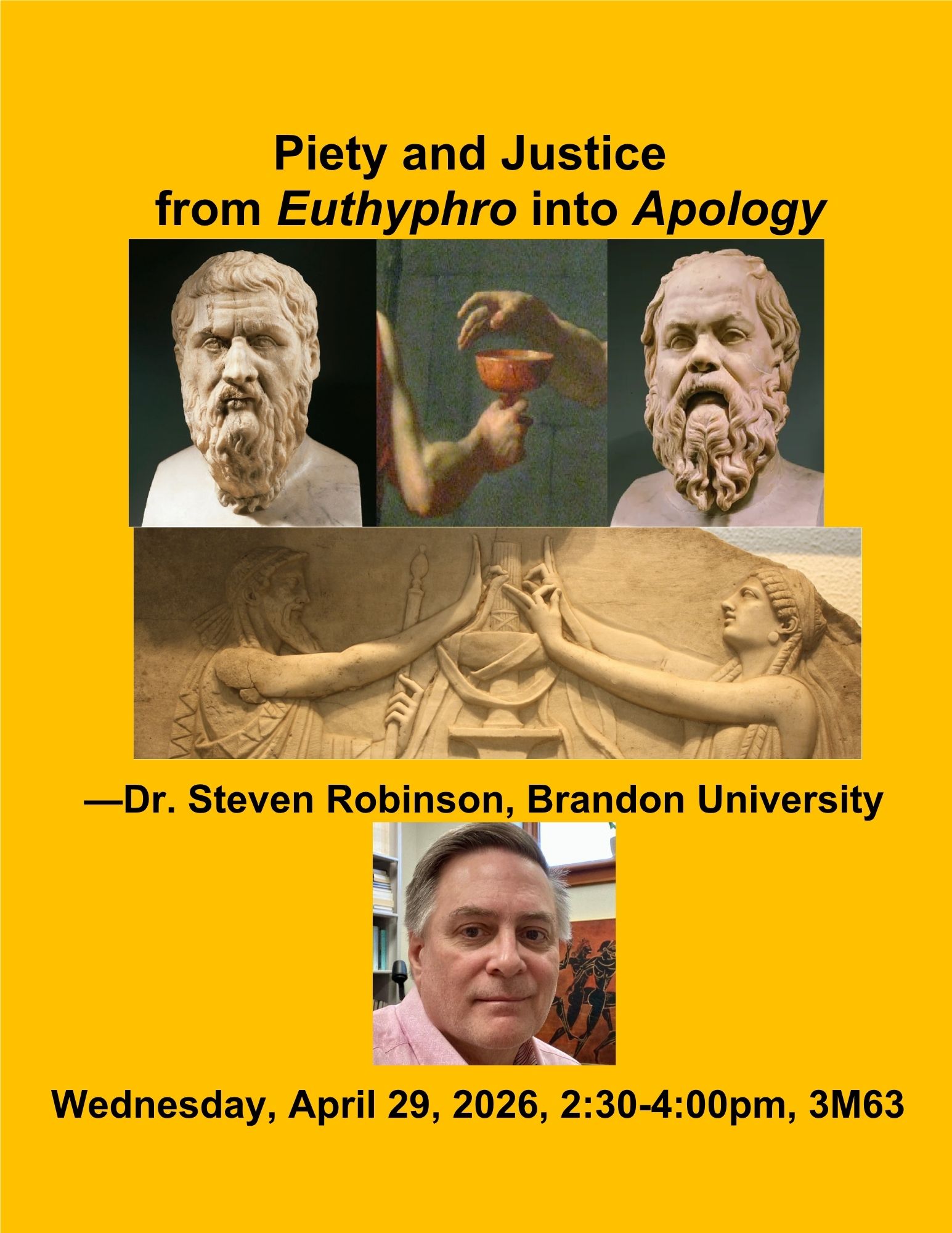
Dr. Steven Robinson, Brandon University
Wednesday, April 29, 2026
2:30-4:00pm
3M63
In Plato’s Euthyphro, Socrates seeks a definition of “piety” so as to defend himself at his upcoming trial. After several false starts Socrates brings the discussion to what looks like a culmination: just specify the product of the gods’ work, which the gods achieve by using humans as their servants, and Euthyphro will have supplied the definition of piety that Socrates needs. But Euthyphro balks, and the dialogue ends in aporia with Socrates bemoaning his failure to have learned anything.
Some scholars have suggested that it is not diFicult for readers to infer a solution that Socrates (or Plato) was “hinting” at, i.e., that the gods’ work is to complete the growth of each human. In this paper I argue that we can be more specific if we look to Socrates’ Apology to see how his actual defense plays out. The reasoning in question (Euthyphro 11e-14b) analogizes piety with artisanal production, taking gods as the artisans. Then, like shipbuilders’ slaves helping to build ships, pious humans assist the gods in their production of complete humans. Piety emerges as the human obligation to assist others in becoming just or good and, hence, it is quite simply the opposite of “corruption.”
In Apology, Socrates’ defense implicitly uses this definition of piety, but also pushes it farther: he claims to be serving the god in his practice of philosophy; he recounts public evidence of how he has set the best example for Athenian youth; and—crucially—he insists that the unexamined life is not the life for a human being. Piety itself then must be understood to include Socratic philosophy, or the practice of critical thinking.
Implications include that Socrates is emphatically innocent at trial; that piety is not primarily a religious concept but a second-order moral concept; and that the main areas of life traditional piety touches on (religious observance; honouring the family; respecting the law) are not grounds of piety but rather instrumental means to the moral maturity of a community. Should religion, family or the laws ever get in the way of the production of good people, then piety must correct them.