
Beading Metis Resurgence: Conversation with the Artists
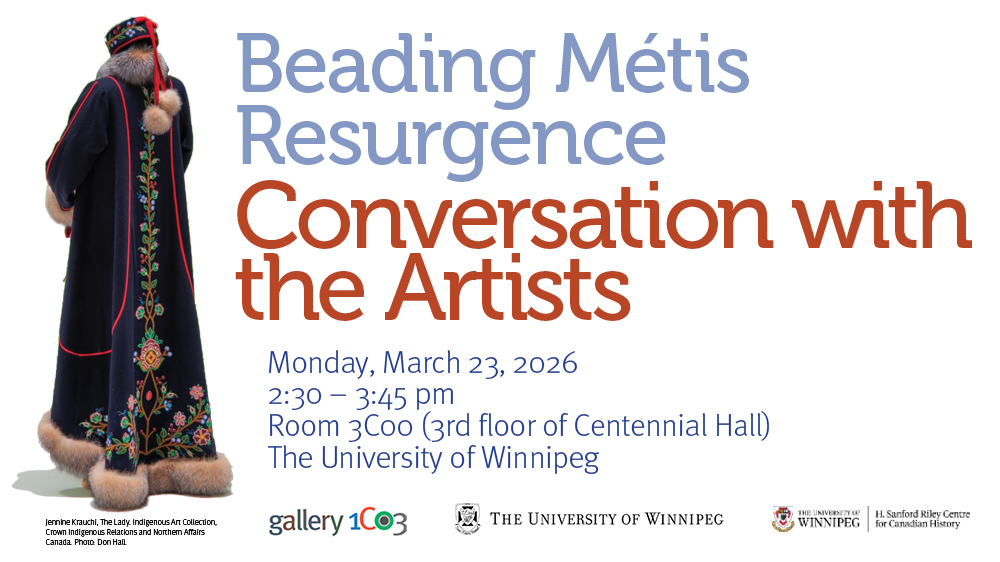
Monday, March 23, 2026
2:30 to 3:45 pm
Room 3C00 (Third floor of Centennial Hall), The University of Winnipeg
Event Recording
Exquisite beaded artworks made by David Heinrichs, Vi Houssin, Claire Johnston, Jennine Krauchi and Brianna Oversby are featured in the Beading Métis Resurgence exhibition, on view at Gallery 1C03 until July 10. These five artists will join exhibit curators Jennifer Gibson and Cathy Mattes to discuss their creative practices in this free conversational event. All are welcome to attend.
This event is presented with support from the University of Winnipeg Office of the Dean of Arts and History department and the Riley Fellowship Fund.
ABOUT THE ARTISTS
David Heinrichs (he/him) is a Queer Michif beadworker from Winnipeg. David began beading about thirteen years ago, but over the last seven years he became more intentional about time spent working with beads, visiting ancestor pieces in the Manitoba Museum and other archives. He has also worked with porcupine quills and silk embroidery using techniques found in historical Métis art. David has created pieces for those close to him, gifting and adorning them with beadwork to show them that they are loved and honoured. He incorporates his academic background in biological sciences and his passion for connection with the land and plant kin into his beadwork. His work also shares parts of his family’s history and story whether that is stories of the ancestors, or his immediate family. As a queer man, creating beadwork allows him to subvert colonial gender roles and expectations. His family names include Poitras, Champagne, Fisher, and Grant with recent family connections to St. Vital and St. Boniface. He is a citizen of the Manitoba Métis Federation and a member of the Two-Spirit Michif Local who lives in Winnipeg with his partner, cat, and dog. His work has been shown at Remai Modern, C2 Centre for Craft, Buhler Gallery in Canada, and at Musée cantonal d'archéologie et d'histoire in Switzerland.
Vi Houssin (she/her) is a transgender beadwork artist and drag performer. Her family is of white settler and Red River Métis ancestry. Her Métis family names are Ritchot, Poitras, Larence and Plante, and her ancestors held scrip in St. Vital and St. Boniface. She is a proud member of the Two-Spirit Michif Local and a citizen of the Manitoba Metis Federation. Vi works and lives in Winnipeg, Canada on Treaty 1 territory where she was born and raised. Vi’s work explores the conventions of beadwork as an artistic medium, and as an expression of her Indigeneity. She uses both a traditional Métis two-needle stitch method as well as off-loom beadweaving in her work to honour her Michif heritage and contribute to the proud craft of her ancestors. She seeks to continue the legacy of contemporary Indigenous artists who affirm that their craft is art, not just artefact, and challenge the fiction that Métis art and culture are sedentary. Vi’s work has been supported by the Canada Council for the Arts. She has exhibited her work locally, nationally and internationally. Her most recent show, the solo exhibition Landfear, was presented in 2025 at aceartinc.
Claire Johnston is a Red River Métis and settler visual artist based in Winnipeg/Treaty 1 Territory. Some of Claire’s Métis family names include Johnston, Brown, Richards and Thomas. Heavily inspired by the aesthetics of historic Métis Grandmother beadwork, Claire creates slow floral beadwork that responds relationally to the past and present. As a teacher and learner, they believe strongly in supporting Métis material art traditions, which are often laboriously sustained by Métis women and Two-Spirit people. In 2025 Claire was selected as a Canada Council Venice Fellow to study Venetian conterie (seed beads) and their connection to Métis beadwork. In Venice, they visited with impiraresse (traditional bead threaders) and learned about the history and preservation of Venetian glass bead traditions. In the past three years, Claire's work has been shown locally at Nuit Blanche, Urban Shaman Gallery, Rosemary Gallery, University of Manitoba School of Art Gallery, and Festival du Voyageur. Nationally their work has been exhibited at Tangled Arts and the Bill Reid Gallery, and internationally at at Le Musée cantonal d'archéologie et d'histoire in Lausanne and at the Venice Biennale of Architecture. Claire is currently working on a large-scale public artwork commissioned by the Winnipeg Arts Council, scheduled to be unveiled in September 2026. Claire is a Sundancer, a step-parent, an auntie, and an MMF citizen with membership with the Two-Spirit Michif Local.
Jennine Krauchi is an internationally recognized Métis artist and citizen of the Manitoba Métis Federation, whose work is profoundly rooted in her culture and community. As an artist, teacher, mentor and advocate, Krauchi has championed the shared inheritance of Métis beadwork, and her work connects its rich past to contemporary concerns. A descendant of Pierre McLeod and Jane Monkman, she learned beadwork from her mother and sewing from her father, and later spent many years learning from her Métis and First Nations elders. Her media include beadwork, quillwork, embroidery and textile design. Her work has been shown and collected by museums and galleries in Switzerland, Ireland, Scotland, France, United States, and Canada. Krauchi also works as a historical consultant for museums in both Europe and Canada. Her art has been included in exhibits at the National Gallery of Canada, Remai Modern, Winnipeg Art Gallery, the Textile Museum of Canada and the Canadian Museum for Human Rights, among many more. She was commissioned to design a commemorative silver coin honouring the Métis Nation for the Royal Canadian Mint. Krauchi is currently working on a major permanent outdoor beadwork façade for the Red River Métis National Heritage Centre in Winnipeg. In 2024, she received the Manitoba Arts Council Award of Distinction, the Winnipeg Arts Council Making a Difference Award, and an Indspire Award. She devotes significant time to leading workshops and mentoring emerging artists to share her expertise.
Brianna Oversby (they/them) is a teacher and interdisciplinary artist living along the Winnipeg River on Red River and Treaty 1 Territory. Their family are Scotts-Métis, German, British & Irish settlers. Brianna's Métis family are originally from the Ochre River/Makinak area of Manitoba, and before that Poplar Point. Their ancestors claimed scrip in Poplar Point, St. Paul, and St. James, and family names include Wishart, Spence, Flett, Hallett. Brianna is a member of the MMF (2S Michif Local). Brianna has a fire for learning to stitch and build the things we need. Their practice is held by a passion for the land and is rooted in utility, belonging and remembering. Brianna incorporates aspects of Métis handwork and craft practices alongside techniques from their other lineages and fine arts practices across disciplines. In 2020 Brianna (Breezy) published 'The Saddle Hurts, Too', a short volume of poetry and essays with Metatron Press. Brianna has a BFA in Art Education from Concordia University and completed their M.Ed at the Harvard Graduate School of Education, where their focus was on building healing-informed practice for learning spaces.
ABOUT THE CURATORS
Cathy Mattes (MMF citizen, Westman local, Southwest Region) is a curator, writer, and art history professor based out of Sprucewoods, Manitoba. Her curation, research and writing centers on dialogic and Indigenous knowledge-centered curatorial practice as strategies for care. She has a PhD in Indigenous Studies from the University of Manitoba, and she currently teaches at the University of Winnipeg in the History of Art and Curatorial Studies programs. Mattes has been beading since she was 20 years old and has taught beading and moccasin-making in workshops, university courses, and around her kitchen table with family and friends.
Jennifer Gibson is Gallery 1C03’s Director/Curator. She is a settler of Ukrainian and French-Canadian heritage who is grateful to be living and working in Winnipeg on Treaty One Territory. Over the past 25 years, she has organized dozens of exhibitions of artists living and working in and beyond Treaty One Territory, especially those from equity-deserving communities. Through her work, she aims to promote an accessible, though rigorous, multi-disciplinary approach to learning through the visual arts. She is a proud alumna of the University of Winnipeg (BA, Honours) and has a Master of Arts degree in Canadian Art History from Carleton University.
GETTING HERE AND ACCESSIBILITY
Maps of The University of Winnipeg campus, including accessibility and parking maps, can be found at https://www.uwinnipeg.ca/maps/. Room 3C00 is located on the third floor of Centennial Hall, marked with a "C" on the campus map, and two floors above Gallery 1C03. Accessible, street level visitor entrances with auto door openers and ramps are via Portage Avenue, Ellice Avenue and Spence Street. The nearest elevator access to Room 3C00 is located on the main floor of Centennial Hall.