Human Rights Alumni of the Month Profile- May 2026
Fri. May. 8, 2026
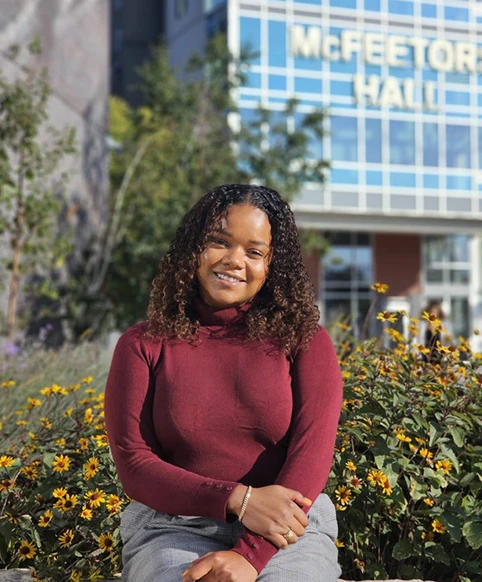
Chelsea Bannatyne
BA (4-Year), Human Rights & Urban and Inner-City Studies, 2022
Master of Development Practice: Indigenous Development, 2025
Chelsea Bannatyne’s path into Human Rights started long before university. Growing up in Winnipeg as an Afro-Indigenous woman with Anishinaabe and Barbadian roots, she was already noticing the gaps around her, especially when it came to justice, health, and social outcomes in Indigenous and racialized communities. She didn’t just see inequality, she kept questioning it. Why does this happen? Who is responsible? What actually changes things?
That questioning is what led her to the Human Rights program at the University of Winnipeg. Her connection to the university began earlier through the Collegiate Model School program, and after graduating, she was considered for one of the reserved seats for recent graduates. Once she started her degree, one course stood out right away. Her first Human Rights class, Emerging Issues in Human Rights, taught by Senator Marilou McPhedran, gave language to things she had been observing her whole life. As she reflects, “it was the first time I felt that many of the issues I had observed growing up were being named and discussed in an academic setting.”
Chelsea chose to double major in Human Rights and Urban & Inner-City Studies, which gave her a more complete view of the issues she cared about. Instead of learning only theory, she was also studying housing, poverty, and systemic inequities directly tied to Winnipeg. That combination mattered because it allowed her to connect broader ideas about justice to the real conditions people are living in every day.
For Chelsea, Winnipeg itself became part of the classroom. The issues discussed in lectures were not distant or abstract. Indigenous rights, urban poverty, housing, child welfare, and social justice are all part of the city’s reality. At the same time, she points to the strength within the city, where community organizations, Indigenous leadership, and grassroots advocacy are actively responding to these challenges. This made it possible to see how learning and action are closely tied.
During her studies, she completed a practicum at 1JustCity. The experience was meaningful because she comes from the same community as many of the people involved, and it felt aligned with giving back and being of service. She describes it as work grounded in “dignity, care, and advocacy,” which reinforced her commitment to community-based work.
After graduating with her BA in 2022, Chelsea continued her education and completed a Master of Development Practice: Indigenous Development in October 2025. Since then, she has worked in community-based research, policy, youth support, and advocacy roles. Her work has included research with the University of Manitoba’s Inner-City Social Work department, policy work with the Manitoba Inuit Association, and her current role as a 2SLGBTQQIA+ Capacity Building Liaison with Sunshine House.
The Human Rights program gave her a foundation in critical thinking, systems analysis, and advocacy. It helped her understand how policies and institutions impact communities, especially Indigenous and racialized populations, and continues to shape how she approaches her work today.
Looking back, the program played a major role in shaping both her academic and professional direction. As she explains, “it gave me the tools to better understand systemic issues and helped guide me toward a career rooted in advocacy, research, and community well-being.”
Her advice to students reflects that same grounding. Stay connected to the reason you chose this field in the first place. Human Rights can be both challenging and meaningful. Engage with the community, ask difficult questions, and don’t be afraid to bring your own lived experiences into your learning.