Human Rights Spring and Summer 2026 Courses
Thu. Mar. 19, 2026
The Spring/Summer timetable is now available to view on WebAdvisor. If you have any questions about the scheduled courses, please contact Dr. Kenyon kr.kenyon@uwinnipeg.ca
Spring Courses
HR 2100: International Human Rights Law in Context
June 8 - June 23, Monday - Friday 1 - 4 p.m.
Instructor: Katrina Leclerc
This course will examine the origins, codifications, and impacts of international human rights law. Students will learn about the different types of rights (political, civil, social, economic, and cultural) and how they are legally protected. Focusing on United Nations treaties and conventions, the course will explore how these documents are written, how they shape international norms, and what legal accountability entails. Reflecting on the current international human rights landscape, the course will also analyze evolving human rights issues such as environmental rights and technology rights.
* HR 2100 was formerly Concepts and Conventions in Human Rights. Students can only receive credit once for HR 2100.
HR 2650: Music and Human Rights
May 4 - June 15, Tuesday/Thursday 9 a.m. - 12 p.m.
Instructor: Steve Dueck
This course explores the deep connections between music and human rights movements across time and place. Through artists ranging from Bad Bunny, Billie Holiday, Lady Gaga and Bob Dylan to Bob Marley, Kendrick Lamar, Chappell Roan, and Sabrina Carpenter, students will examine how music reflects, shapes, and challenges social realities. We will analyze songs that confronted racism, fueled civil rights and labor movements, resisted colonialism and apartheid, amplified LGBTQ+ voices, defended Indigenous sovereignty, and addressed global crises such as environmental destruction, nuclear war, forced migration, and child trafficking.
* FYI - if you have taken HR 2650 with a different title, you can still take this course.
HR 3650: Representing 2SLGBTQ+ Rights
May 4 - June 15, Tuesday/ Thursday 6 - 9 p.m. OR asynchronous online
Instructor: Scott de Groot
This course introduces sexuality as a domain of historical inquiry, surveys the history of queer oppression and resistance in Canada, and analyzes contemporary representations of the long, ongoing struggle for 2SLGBTQ+ rights. It pays special attention to the role of cultural institutions, such as museums and heritage sites, in shaping narratives and public understandings of queer history and 2SLGBTQ+ activism. It considers the limitations and possibilities of these institutions for connecting the past with the present – especially in ways that foster critical dialogue, spur reinterpretation, occasion artwork, and provoke action. The course will feature conversations with 2SLGBTQ+ scholars, activists, and artists about their work in the realm of public history and cultural production.
* FYI - if you have taken HR 3650 with a different title, you can still take this course.
Summer Coures
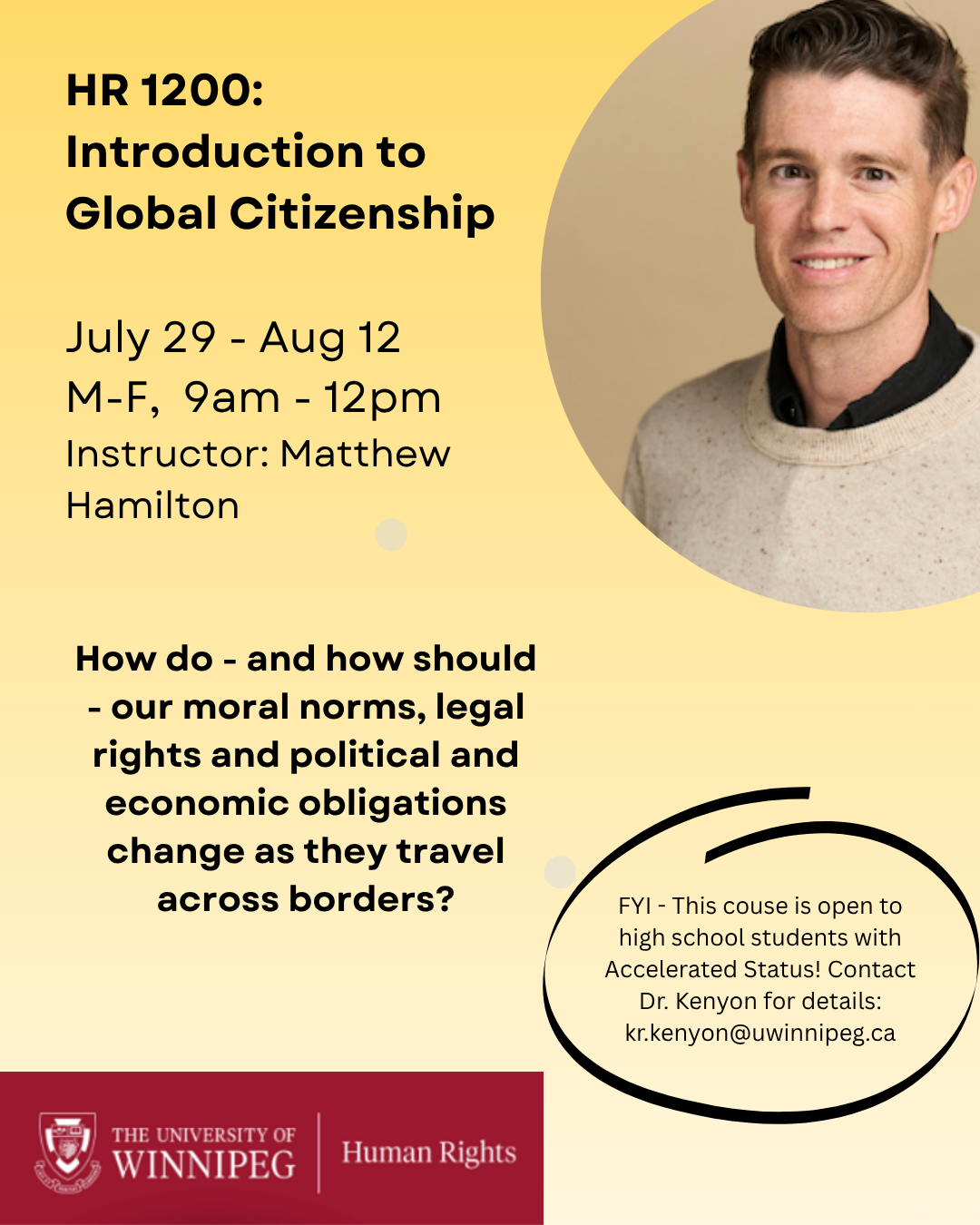
HR 1200: Introduction to Global Citizenship (3)
July 29 - August 12, M-F 9 a.m. - 12 p.m.
Instructor: Matthew Hamilton
This course offers a critical introduction to the contested conceptions of contemporary (global) citizenship and the newly emergent interdisciplinary field of global justice. We will examine the debates and complexities that emerge from diverse articulations of justice, obligation, and rights across the contemporary world. How do - and how should - our moral norms, legal rights and political and economic obligations to diverse others change as they travel across (spatial, temporal and nation-state) borders? Featuring guest speakers: prominent local leaders sharing their diverse experiences acting as global citizens.
*This course is open to high school students with accelerated status, contact Dr Kenyon (kr.kenyon@uwinnipeg.ca) for more information *
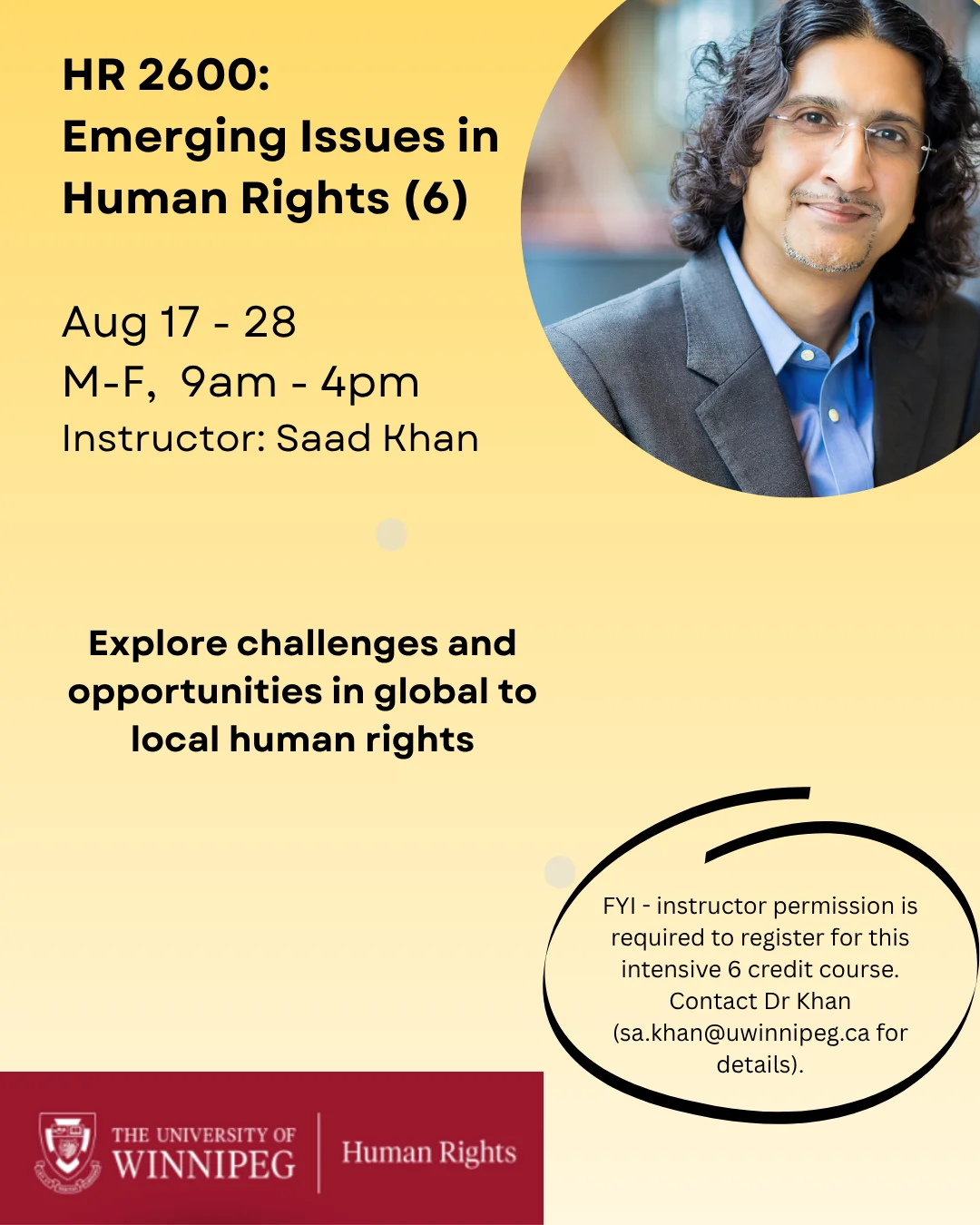
HR 2600: Emerging Issues in Human Rights (6)
August 17 -28, M-F 9 a.m. - 4 p.m.
Instructor: Saad Khan
This intensive six-credit course is designed to introduce students, in a range of disciplines and students entering university, to challenges and opportunities in global to local human rights, by cultivating foundational skills for academic success. In both classroom and community settings, students explore global issues using the city as our human rights 'campus' through current news items, literature, and social analysis from diverse perspectives, shaped by research expertise in Global College and beyond.
*Instructor permission is required to register for this course, contract Dr.Khan (sa.khan@uwinnipeg.ca) for more information *
HR 4650: Special Topics in Human Rights: Human Rights Work (3)
August 17-21, M-F 9 a.m. -4 p.m.
Instructor: Shauna Labman
This intensive one-week course seeks to explore when and how human rights are respected, protected, and fulfilled both locally and globally. How are human rights measured and how are advocacy campaigns evaluated for success? Ultimately, are human rights working and how do we know? The course will also examine what it means to do human rights work, exploring potential career paths for working in the field of human rights. Students will be encouraged to think critically about what it means to pursue a career that puts you up against human rights violations as you push for protections and recognition. Full attendance and participation are necessary for success in this course. Classes will be collaborative, exploratory, reflective, and discussion based. There will be daily in class assignments and one final group assignment.
* Prerequisites for this course: HR 2100, HR 2200 and six additional credits in Human Rights or permission of the instructor (s.labman@uwinnipeg.ca). *