Human Rights Alumni of the Month Profile- March 2026
Wed. Mar. 18, 2026

Abhijot Kaur Chohan (BA Human Rights, 2025)
Minor in Conflict Resolution Studies
Abhijot Kaur Chohan (she/her) graduated in 2025 with a three-year Bachelor of Arts in Human Rights from Global College at the University of Winnipeg and completed a minor in Conflict Resolution Studies. She currently works as a program lead and case manager in the community development sector, supporting refugee and newcomer populations through settlement, advocacy, and access to essential services, while also pursuing a Master’s degree in Development Studies and Diplomacy.
Abhijot chose to pursue Human Rights at Global College because she wanted an education rooted in social justice that also connected to real-world change. She was drawn to the program’s interdisciplinary approach and emphasis on critical thinking, advocacy, and community engagement. She first learned about the Human Rights program after enrolling in another degree at the University of Winnipeg and was impressed by how Global College links academic learning with both local and global human rights issues.
For Abhijot, studying Human Rights in Winnipeg meant being able to see the issues she learned about in class reflected in the city around her, from migration and housing to Indigenous rights and gender-based violence. These realities made her academic work feel immediate and relevant, and offered opportunities to engage directly with grassroots organizations and community partners.
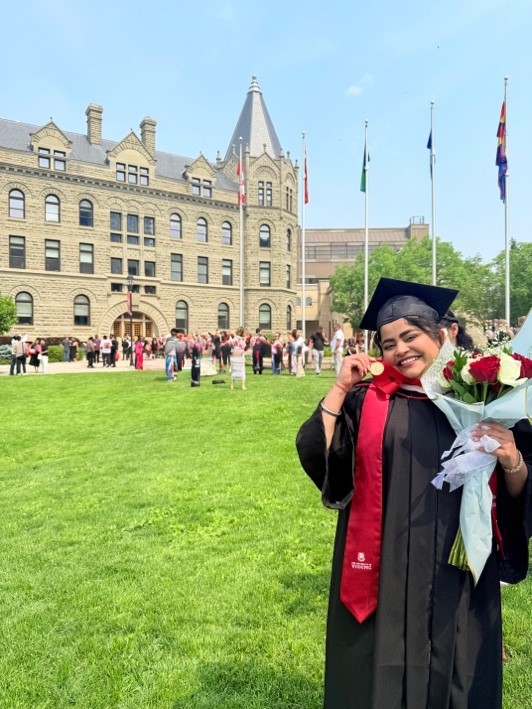 After graduating, Abhijot began working with refugee populations, a path that built on the community development work she had already been doing while a student. In her current role as a program lead and case manager, her day-to-day work involves a combination of direct client support and program coordination. This includes assisting clients with settlement needs such as housing, access to healthcare, documentation, and navigating social service systems, as well as advocating on their behalf within complex institutional structures. She also works closely with community partners and support staff to ensure programs are responsive to clients’ needs and grounded in dignity and rights. At the same time, she is deepening her academic foundation through graduate studies in Development Studies and Diplomacy, integrating her human rights perspective into broader questions of policy, development, and international relations.
Abhijot says her time in the Human Rights program shaped how she approaches both her professional work and her graduate studies. Courses that focused on systemic inequality and state responsibility strengthened her ability to understand how policies affect individuals on the ground, helping her frame client concerns not only as individual needs, but as rights-based issues. This perspective has been especially valuable when advocating for clients facing barriers within immigration, housing, and social service systems.
Her minor in Conflict Resolution Studies has also strongly influenced her professional approach, particularly in high-stress or emotionally charged situations. Through this training, Abhijot developed skills in active listening, mediation, and de-escalation, which she regularly draws on when working with individuals who have experienced trauma. She notes that these skills have also been important in navigating workplace dynamics and collaborative problem-solving within multidisciplinary teams.
Some of her most memorable learning experiences came from being challenged in the classroom. She recalls engaging in debates with Professor Khan, which pushed her to defend her ideas and think more deeply, as well as the rigorous preparation required for Professor Hamilton’s classes, which helped her refine her analytical and writing skills. These experiences contributed to her confidence as a thinker, writer, and communicator.
“What set the Human Rights program apart was its ability to connect theory to lived realities, preparing me to advocate effectively in complex community and international contexts.”
What Abhijot values most about the Human Rights program is its ability to connect theory to lived realities. Faculty encourage open dialogue and critical debate, prompting students to question power, systems, and their own assumptions.
Abhijot encourages current and prospective students to engage fully, ask questions, challenge ideas, and connect coursework to what is happening in the community, the more they do that, she says, the more meaningful their Human Rights education becomes.