
The history of the ICR reminds us that Winnipeg is a place defined as much by social change and Indigenous-led political action as it is by racism.
Dr. Leah M. Kuragano
Assistant Professor, Department of History
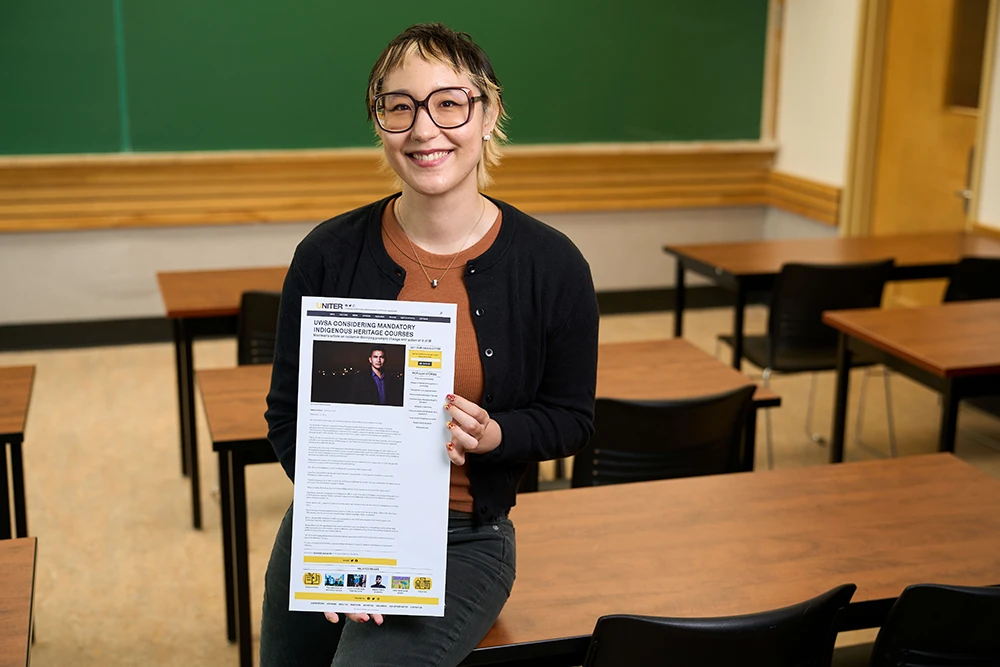
Reflection on a 2015 article from The Uniter: “UWSA Considering Mandatory Indigenous Heritage Courses: Maclean’s article on racism in Winnipeg prompts change and action at U of W”
In January of 2015, Maclean’s magazine published an article titled “Welcome to Winnipeg: Where Canada’s racism problem is at its worst.”[1] The article describes how the recent murder of teenager Tina Fontaine (Sagkeeng First Nation) unveiled Winnipeg’s supposedly exceptional culture of anti-Indigenous racism. Following the Maclean’s article, The Uniter reported in February of 2015 that the University of Winnipeg Student Association (UWSA) was responding by calling for structural changes, namely the implementation of what would become the Indigenous Course Requirement. This archival record highlights a foundational purpose of the ICR: to influence cultural change in Winnipeg.
When I arrived in 2022 from the U.S. to take a faculty position in the U of W History Department, locals often encouraged me to read the Maclean’s article for important insight about my new home city. Many of them parroted the idea that Winnipeg was the “most racist” city in Canada. But as a historian of race and racism, I knew that there was more to the story. As Anishinaabe writer and activist Niigaan Sinclair (Peguis First Nation) asserts in his recent book Wînipêk: “Racism isn’t a Winnipeg problem; it’s a Canadian issue that’s seen most clearly in Winnipeg.”
Sinclair also says in Wînipêk that “racism isn’t what defines Winnipeg, it’s the ways racism is addressed that defines it.” Anti-Indigenous racism in Winnipeg is very real, but so too is Winnipeg’s deep-seated culture of social change and Indigenous-led political action. The ICR represents this culture and, furthermore, reminds us that students at the University of Winnipeg have long been leaders and change-makers in our city. But a key question remains: How has the ICR been successful in its mission to curb anti-Indigenous racism in Winnipeg?
[1] https://macleans.ca/news/canada/welcome-to-winnipeg-where-canadas-racism-problem-is-at-its-worst/